
Best 7 strategies to increase student motivation online
 July Mayer —
Are you struggling to involve your online students and motivate them? Here are some workable strategies for online student engagement strategies to get everyone engaged.
The third millennium is an epoch of online learning and distance learning strategies. What seemed to be unbelievable and sophisticated just a decade ago is a commonplace routine today. Millions of students have embraced the potential of e-learning platforms, enabling them to master any skill and profession from the convenience of their location.
Even more people widen their horizons with a variety of online programs: they learn English, master programming, or flip the classroom with BookWidgets exercises.
But the problem is that online learning differs from face-to-face instruction profoundly. While staying in a classroom and working with a teacher and other classmates, students get much more involved in the process. Working from home is less demanding in terms of attention and focus, so many online learners fail before reaping any progress from their online course. How to improve student engagement in online learning and keep students motivated in an online environment?
Here’s a cheat sheet for teachers to minimize dropout from their courses and help students succeed.
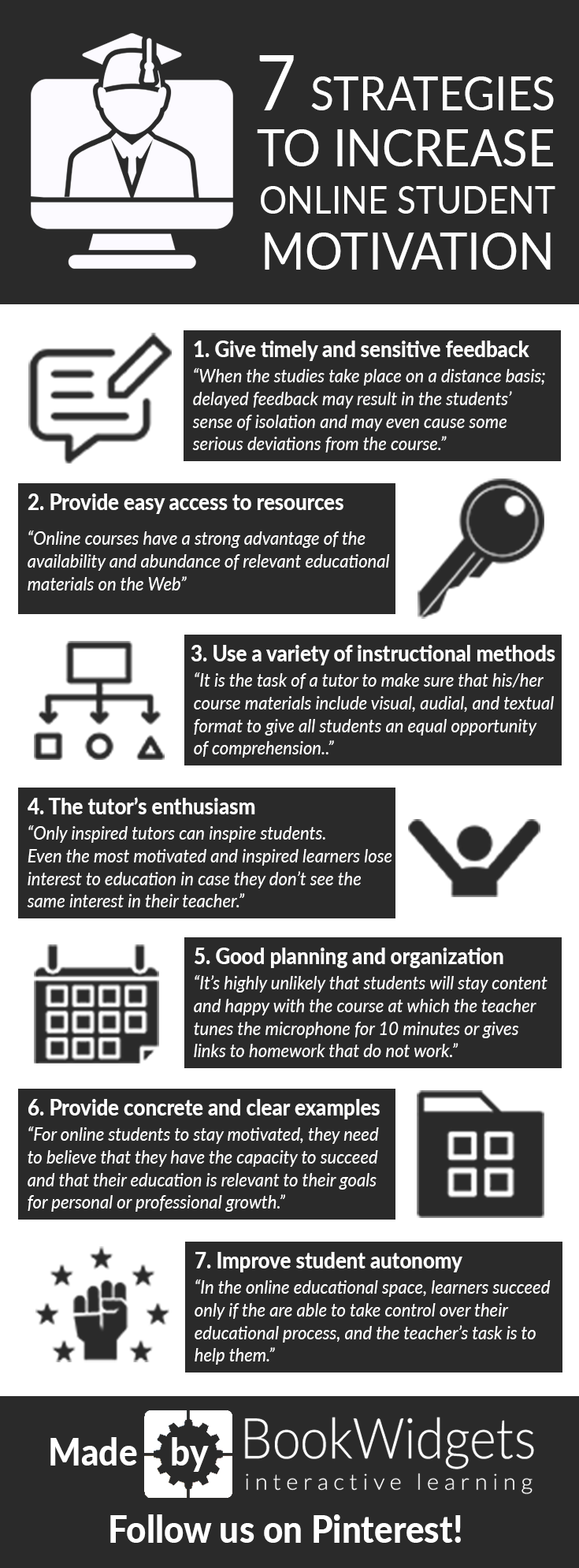
7 tips to keep up student engagement in digital courses
1. Give timely and sensitive feedback
 Feedback is critical in online learning environments. When the educational process takes place in a classroom, the teacher has numerous opportunities to give feedback in real time, thus streamlining students and pinpointing their mistakes early. When the studies take place on a distance basis, delayed feedback may result in the students’ sense of isolation and may even cause some serious deviations from the course.
In the 21st century, educational technology tools is highly helpful for tutors, and you can make use of some programs to give sensitive feedback right at the time when your students require it:
- Share verbal feedback with students via the Talk & Comment Chrome extension.
- Provide video feedback with screen recording captions with the help of TechSmith
- Arrange videoconferences with Zoom to discuss important issues and give virtual feedback sessions for students
- Create activities with tools that have feedback built-in, such as BookWidgets
2. Provide easy access to resources
 Providing learning resources is one of the key advantages of online courses, thanks to the availability and abundance of relevant educational materials on the web. Thus, your task as a tutor is to provide guidance on further reading and studying by giving links to free, easily accessible digital learning resources for students. In such a way, you will make sure that students will always access them and get all the information they need.
This is easily achievable if you give links to:
- Wikipedia as the starting point for self-directed online learning
- YouTube channels with useful educational material for video-based learning
- A BookWidgets webquest with online widgets (or exercises), links to webpages, video materials and much more. You can even embed Wikipedia pages and YouTube Videos to give the full multimedia learning experience!
- Your personal resources carefully prepared and uploaded to the course website, accessible to enrollees of your course - Tip: Use a Google Drive for organizing digital teaching materials!
However, always make sure that you direct students towards materials that are free from copyright or are officially distributed on the web with consent of their owner. Too much material is illegally published on the internet, so using such materials may be an academically unfair practice. If you want to share images that are free of copyright, you can find them right here.
3. Use a variety of instructional methods
 People are not universal; some students perceive information in a visual learning style better, while other are auditory learners. Students have different cognitive styles, and the real-life classroom gives a richness of educational opportunities for students of all kinds, but in online learning, some components may lack, leaving some students beyond the scope of effective studying. Thus, it is the task of a tutor to make sure that his/her course materials include multimodal learning strategies and combine visual, auditory, and textual format to give all students an equal opportunity of comprehension.
In practice, you can achieve that variety by enriching every lesson with:
- Textual information in the lesson for reading-based learning
- A video explaining and illustrating key points for video-based instruction
- A discussion board or live session with students for engagement.
- A PowerPoint presentation with core material for structured digital lessons
In this blog post, you’ll find several examples that you can share with your students.
4. The tutor’s enthusiasm
 This one is maybe a cliché but we all know it is the truth: only inspired tutors can inspire students. Even the most motivated and inspired learners lose interest to education in case they don’t see the same interest in their teacher, so it’s the critical role of the tutor to serve as a living example of passion towards the subject.
Make interesting lectures, arrange emotional and involved discussions, repeatedly link the course material to real life, and you will see even the struggling learner pursue the course with stubbornness and resilience. This will surely be a rewarding experience!
You could for example use memes in your lessons or provide different options for students with different interests.
5. Good planning and organization
 A real-life classroom affords some improvisation because of the numerous kinds of activities that groups can conduct. However, in an online learning environment, good planning and organization are the key to effective teaching and student engagement.
It’s highly unlikely that students will stay content and happy with the course at which the teacher tunes the microphone for 10 minutes or gives links to homework that do not work. So, planning is vital in both technical and educational terms to make the learning process smooth and students satisfied.
An excellent way to guarantee flawless, engaging organization of your online lessons is to rely on modern technology for lesson design (such as BookWidgets). You also reap benefits in the form of quicker lesson planning, less time spent on grading, and the use of contemporary ICT in technology-enhanced learning.
If you want to boost your productivity as a teacher, you might want to take a look at these great productivity apps.
6. Provide concrete and clear examples
 Even the most theoretical fields of knowledge can be tied to specific real-life situations, which gives ultimate meaning to studies.
Research suggests that for online students to stay motivated, they need to believe that they have the capacity to succeed (that is, possess competence) and that their education is relevant to their goals for personal or professional growth.
By giving concrete examples and linking theory to practice, teachers ensure the relatedness of their course, which is an important factor in improving student engagement and has a long-term positive impact on motivation.
7. Improve student autonomy
 Finally, it is critical to stay true to the essence of online learning, also called self-directed learning. In the online educational space, learners succeed only if the are able to take control over their educational process, and the teacher’s task is to help them.
You can improve student autonomy in the following ways:
- by creating the calendar of assignments and the schedule of materials to be studied for the course (for students to schedule their work on the course materials flexibly without being given a piece of data every week) - Here's an example.
- by involving students in independent goal-setting at the start of the course to encourage self-regulated learning strategies for students and to take the full ownership of the process
- by presenting students to new educational scenarios and situations, thus teaching them to make independent decisions.
As you can see, online learning differs from a traditional classroom, but the times are changing, and we cannot teach by the old standards, ignoring the students’ needs of today. Education is undergoing a fundamental transformation, so helping students succeed requires the change of teachers’ mindset. Adapt to the technological requirements, make your online courses accessible and convenient, and you will reap rewards in the form of students’ progress and gratitude.
About the author
July Mayer is a freelance writer who lives in with her husband, 7-years old son and a medium-sized dog. Before she became a freelance writer, she experimented with various occupations: marketing, dog-training, scientificating… But her favorite job is the one she's now doing full time - writing articles.


