15+ Ready-to-Use Bell Ringer Activities for Every Subject
 Chelsey Both —
The first few minutes of class can be a bit chaotic. Students are walking in, talking to friends, getting their things ready, and settling into their seats. Before you know it, several minutes have passed and the lesson hasn't even started.
A bell ringer gives students something to work on as soon as they walk through the door. While they get started, you can take attendance or get yourself ready for the lesson. Once students get used to starting each lesson with a bell ringer, it can quickly become part of the classroom routine. They know what to expect and can get started without waiting for instructions.
Whether you teach math, science, social studies, a language, or another subject, there are plenty of ways to use bell ringers in your classroom. I've put together 15 ready-to-use ideas for different subjects and age groups, giving you plenty of options for those first few minutes of class.
Ready-to-Use Bell Ringer Activities in This Post
This section gives you an overview of the teacher links to the 16 ready-to-use bell ringer activities we've created. Copy them to your BookWidgets account and start using them in your classroom. You can also find all the activities in this BookWidgets group.
Want to learn more about each activity? Scroll down to find the detailed lesson plans!
- Open this ready-to-use BookWidgets Word of the Day activity for primary and middle school students
- Copy this BookWidgets formula matching activity for primary school math students
- Open this BookWidgets geography reasoning activity for primary school students
- Use this BookWidgets human body crossword for primary school students
- Copy this BookWidgets social-emotional skills reflection activity for pre-k and kindergarten thru 3rd grade
- Open this BookWidgets history recall activity about the discovery of America for middle school students
- Copy this BookWidgets Question of the Day activity for primary and middle school students
- Open this BookWidgets sorting and reasoning activity for middle school biology students
- Use this BookWidgets Shakespeare review activity with a timer for high school English students
- Copy this BookWidgets problem-solving activity for primary, middle, and high school students
- Open this BookWidgets history activity for high school students
- Open this BookWidgets cause-and-effect economics activity with randomized questions for high school students
- Use this BookWidgets independent reading reflection activity for primary and middle school students
- Open this BookWidgets personal reflection activity with daily affirmations for middle and high school students
- Copy this BookWidgets pre-exam readiness check-in for middle and high school students
- Open this BookWidgets article reading and critical thinking activity for middle and high school students
🔎 New to BookWidgets? Here’s what you need to know in three sentences:
- BookWidgets is an all-in-one content creation tool for teachers that helps all teachers create interactive digital assignments and assessments (with a variety of 37 interactive question types).
- Teachers can share BookWidgets evaluation through their connected learning management system, such as Google Classroom, Microsoft Teams, Canvas, Moodle, and many more, making digital activities easy to manage within their existing workflow.
- Students answers are collected and organized in a reporting dashboard, where teachers can review work, give feedback, and evaluate performance efficiently.
Why Use Bell Ringer Activities in Your Lesson
Bell ringers are more than just something for students to do while everyone gets settled. A well-chosen bell ringer can help bring previous learning back to mind and get students thinking before the lesson gets underway.
There are several ways you can use bell ringers in your classroom:
- Activate Prior Knowledge: Bring previous learning back to the surface and get students thinking about what they already know.
- Check Understanding: Get a quick idea of what students understand, where they may be struggling, or what you may need to revisit.
- Review: Give students a chance to practise or recall content from a previous lesson.
- Self-Assessment: Encourage students to think about what they know, what they remember, and where they may need more practice.
- Summarize: Ask students to put key ideas from previous learning into their own words.
- Apply & Connect: Have students connect different ideas or use what they have learned in a new situation.
16 Ready-to-Use Bell Ringer Activities for Teachers
I've put together 16 ready-to-use bell ringer activities that you can adapt to your subject and students. Some are designed to bring previous learning back to mind, while others give students a chance to think a little deeper or approach something in a new way.
1. Word of the Day
| Icon | Area | Explanation |
|---|---|---|
| 🎓 | Subject & Grade | Miscellaneous - Primary & Middle School |
| 🎯 | Learning goal | Students understand and demonstrate the meaning of a new term by defining it and using it in context. |
| 🧩 | BookWidgets widget type | Quiz |
| ⏱️ | Time needed | 5 - 10 minutes |
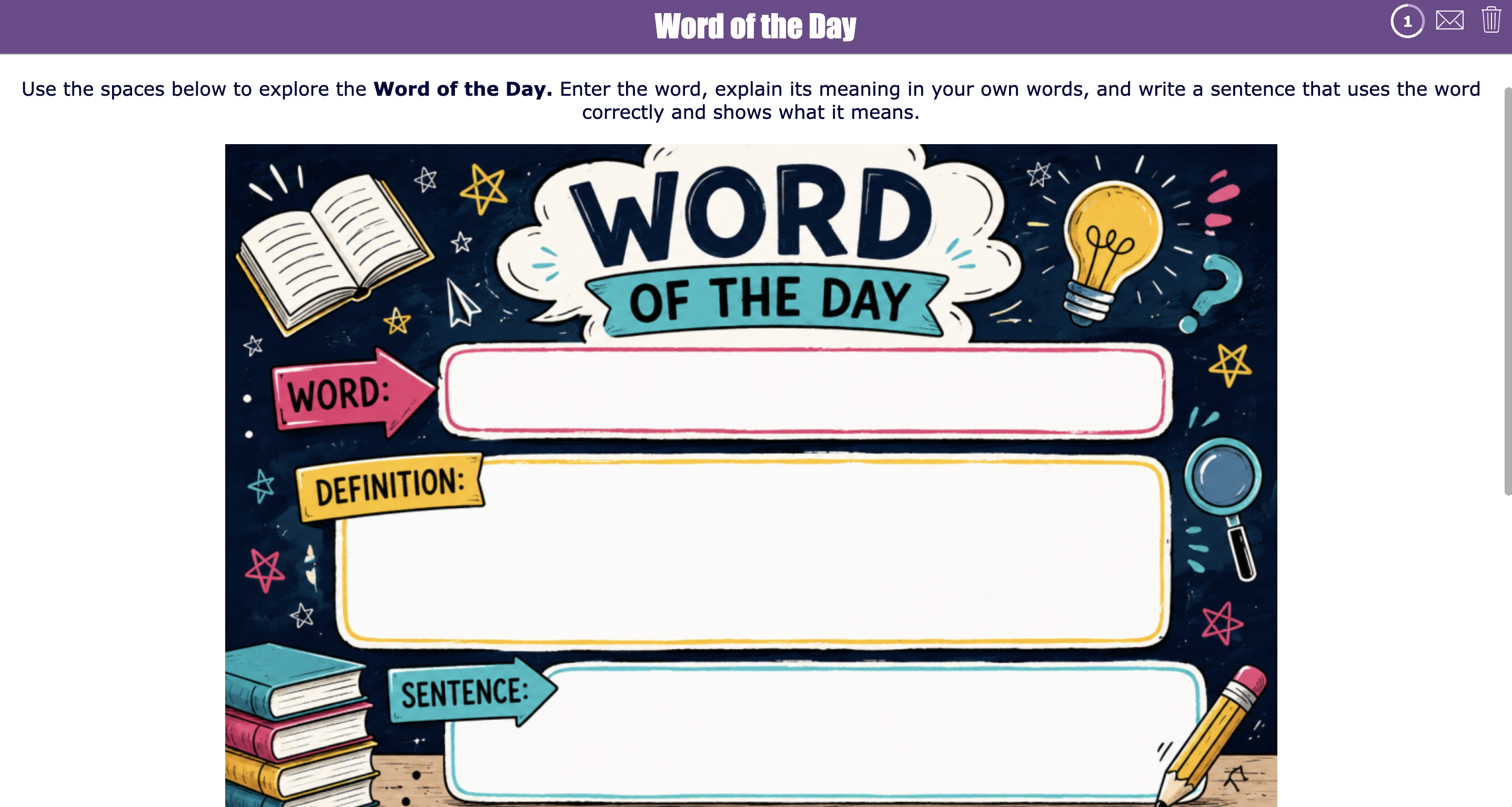
Word of the Day is a simple bell ringer that can be reused throughout the school year. Start by giving students a word related to the subject or topic you're teaching. You can display the word on the board or tell students what it is. They then explain what it means in their own words and use it in a sentence that shows they understand how it can be used.
You can change the word each time you use the widget, making it easy to build subject-specific vocabulary while giving students a quick task to get them thinking at the start of class.
2. Formula Match-Up
| Icon | Area | Explanation |
|---|---|---|
| 🎓 | Subject & Grade | Math - Primary School |
| 🎯 | Learning goal | Students recall and match geometric shapes with their corresponding formulas. |
| 🧩 | BookWidgets widget type | Memory Game |
| ⏱️ | Time needed | 3 - 5 minutes |
Formula Match-Up is a quick memory game that gets students to recall formulas they have learned before. Students match each geometric shape with the formula that belongs to it, helping them bring key formulas back to mind before starting the lesson.
This activity is a way to turn formula review into a quick and engaging challenge while giving students a chance to see which formulas they remember and which ones they may need to revisit. The same matching idea can also be used in other subjects. In a language class, for example, students could match a word in another language with the correct image. In science, they could match scientific terms with their definitions. This makes it a flexible activity that can be used across multiple subjects.
3. Which Country Doesn't Belong?
| Icon | Area | Explanation |
|---|---|---|
| 🎓 | Subject & Grade | Geography - Primary School |
| 🎯 | Learning goal | Students identify differences between countries and explain the reasoning behind their choice. |
| 🧩 | BookWidgets widget type | Worksheet |
| ⏱️ | Time needed | 5 - 10 minutes |
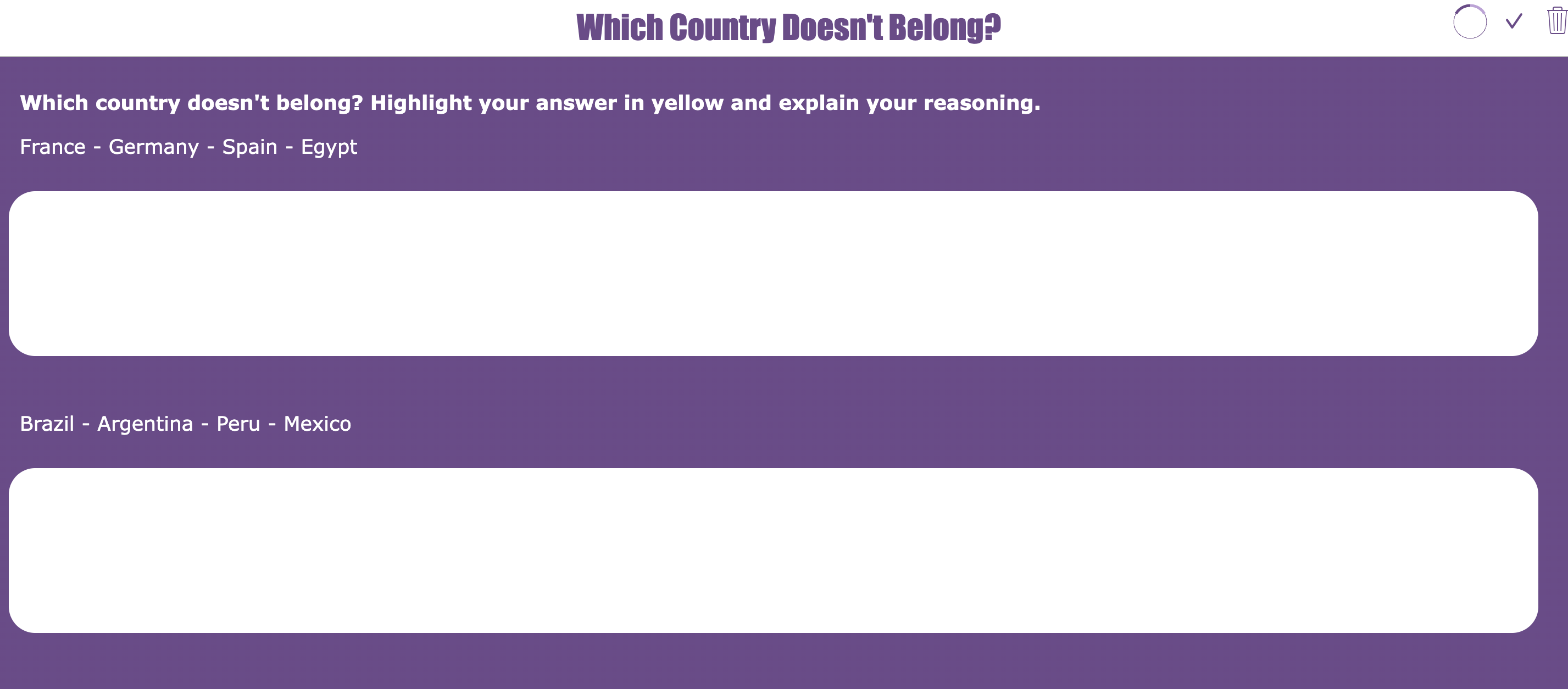
Give students a group of countries and ask them to decide which one doesn't belong. The activity goes beyond choosing an answer. Students look at the countries, identify what makes one different from the others, and put their reasoning into words. This gives them an opportunity to apply what they know while practising how to support their answer with evidence.
4. Human Body Crossword
| Icon | Area | Explanation |
|---|---|---|
| 🎓 | Subject & Grade | Science - Primary School |
| 🎯 | Learning goal | Students recall and identify common human body organs and body parts, along with their functions. |
| 🧩 | BookWidgets widget type | Crossword |
| ⏱️ | Time needed | 5 - 10 minutes |
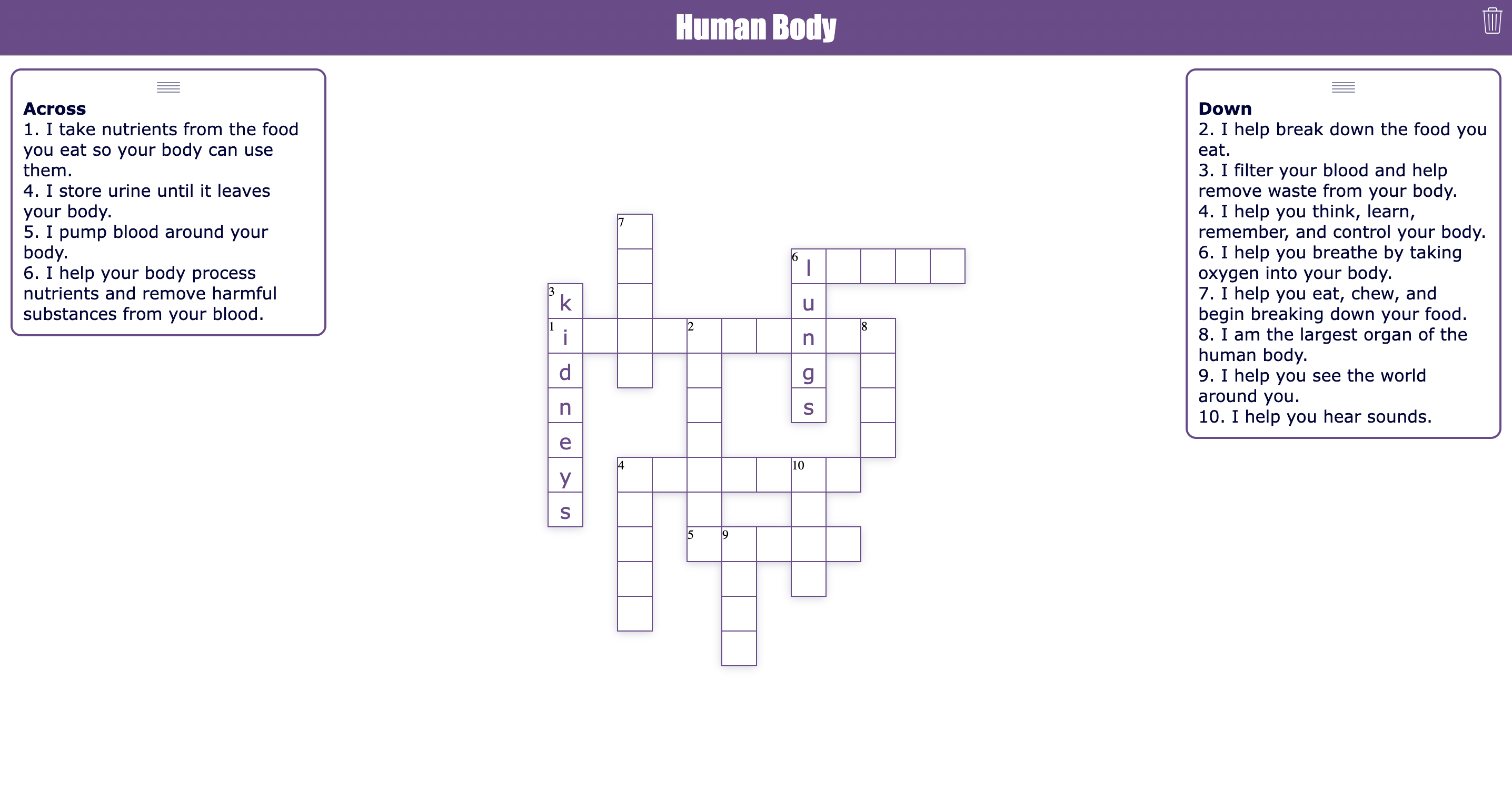
Display the crossword on the board and let students work together to solve it. The clues help them recall the names of different organs and body parts, as well as what they know about their functions. As they work through the clues, students can share their ideas, discuss possible answers, and help each other when they get stuck. It’s also a nice way to bring some teamwork into a content review activity.
5. What Skill Will You Practice Today
| Icon | Area | Explanation |
|---|---|---|
| 🎓 | Subject & Grade | Miscellaneous - Pre-K, Kindergarten thru 3rd grade |
| 🎯 | Learning goal | Students select a social-emotional skill to practise and explain their choice while setting a personal learning goal. |
| 🧩 | BookWidgets widget type | Quiz |
| ⏱️ | Time needed | 3 - 5 minutes |
This bell ringer is designed to be reused throughout the school year. Before students begin an assignment, briefly explain what they will be doing and ask them to think about which skill they will use most. Students choose the skill that best fits the task and explain why they made that choice.
You can change the assignment and skill options each time you use the widget while keeping the same basic structure. This gives students a moment to think about the skills they are practising before they start working.
💡 BookWidgets Teacher tip: Want to use this activity with older students? You can replace the audio recording question with a writing question, allowing students to explain their choice in writing instead.

6. Who or What Am I? History Edition
| Icon | Area | Explanation |
|---|---|---|
| 🎓 | Subject & Grade | History - Middle School |
| 🎯 | Learning goal | Students recall and identify key people, objects, events, and concepts related to the discovery of America. |
| 🧩 | BookWidgets widget type | Flash Cards |
| ⏱️ | Time needed | 5 - 10 minutes |
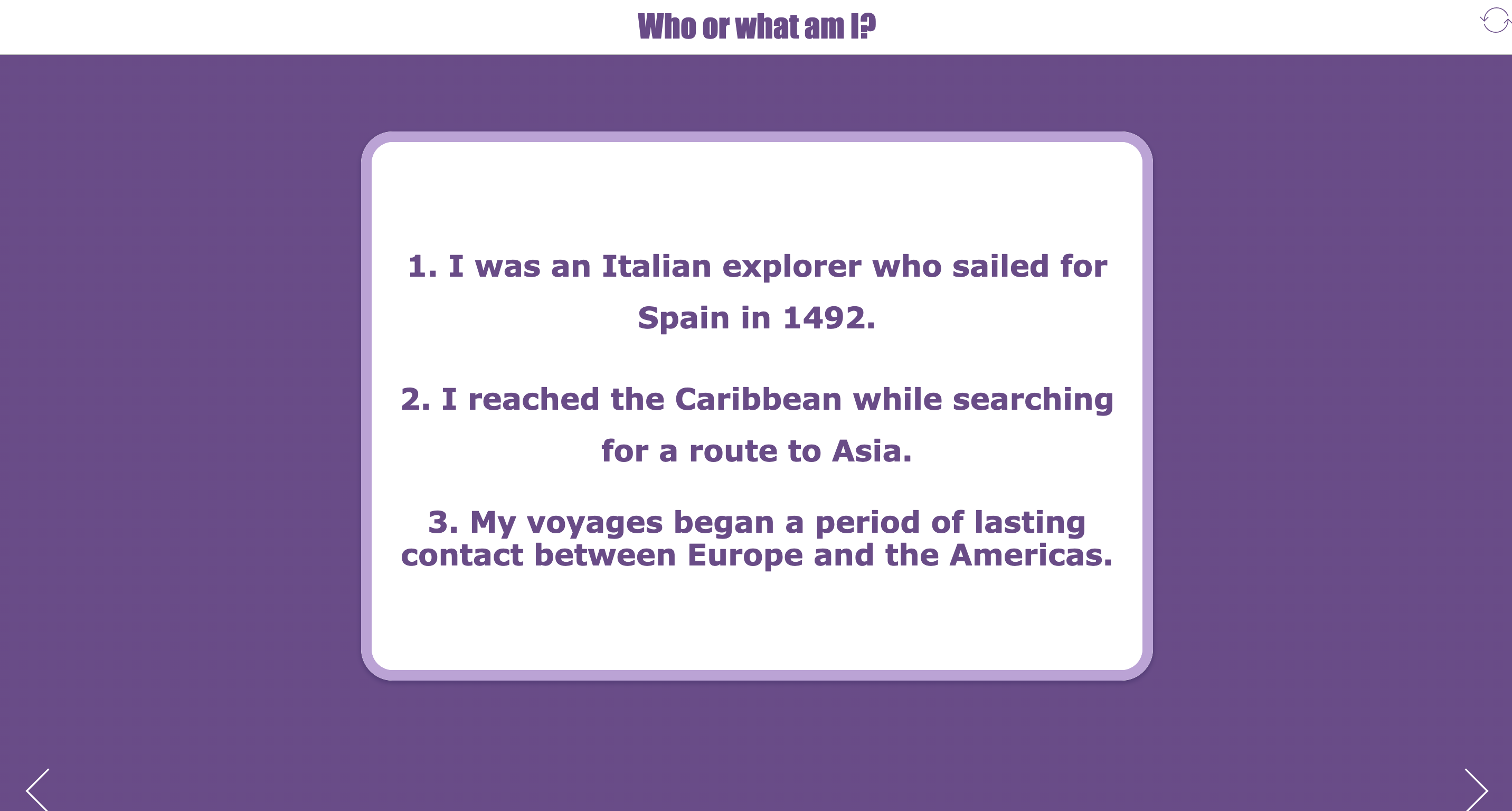
The activity gives students a set of clues about a person, object, event, or concept and asks them to work out who or what is being described. Once they have an answer, they can check it against the information on the next card.
It encourages students to draw on what they already know and use the clues to identify the answer. The cards can be adapted to fit the topic you're currently teaching.
7. Question of the Day
| Icon | Area | Explanation |
|---|---|---|
| 🎓 | Subject & Grade | Miscellaneous - Primary & Middle School |
| 🎯 | Learning goal | Students respond to an open-ended question and communicate their answer clearly. |
| 🧩 | BookWidgets widget type | Quiz |
| ⏱️ | Time needed | 5 - 10 minutes |
This bell ringer gives students a question to answer at the start of class. The question can be related to the topic you're teaching, but it can also be used to get students thinking about a broader idea.
Since the question can be changed each time, the same widget can be used throughout the school year. Students enter the question, write their answer, and use the rubric to check their response before submitting it.

8. Think, Sort, Explain
| Icon | Area | Explanation |
|---|---|---|
| 🎓 | Subject & Grade | Biology - Middle School |
| 🎯 | Learning goal | Students classify information, identify connections, and explain the reasoning behind their choices. |
| 🧩 | BookWidgets widget type | Worksheet |
| ⏱️ | Time needed | 5 - 10 minutes |
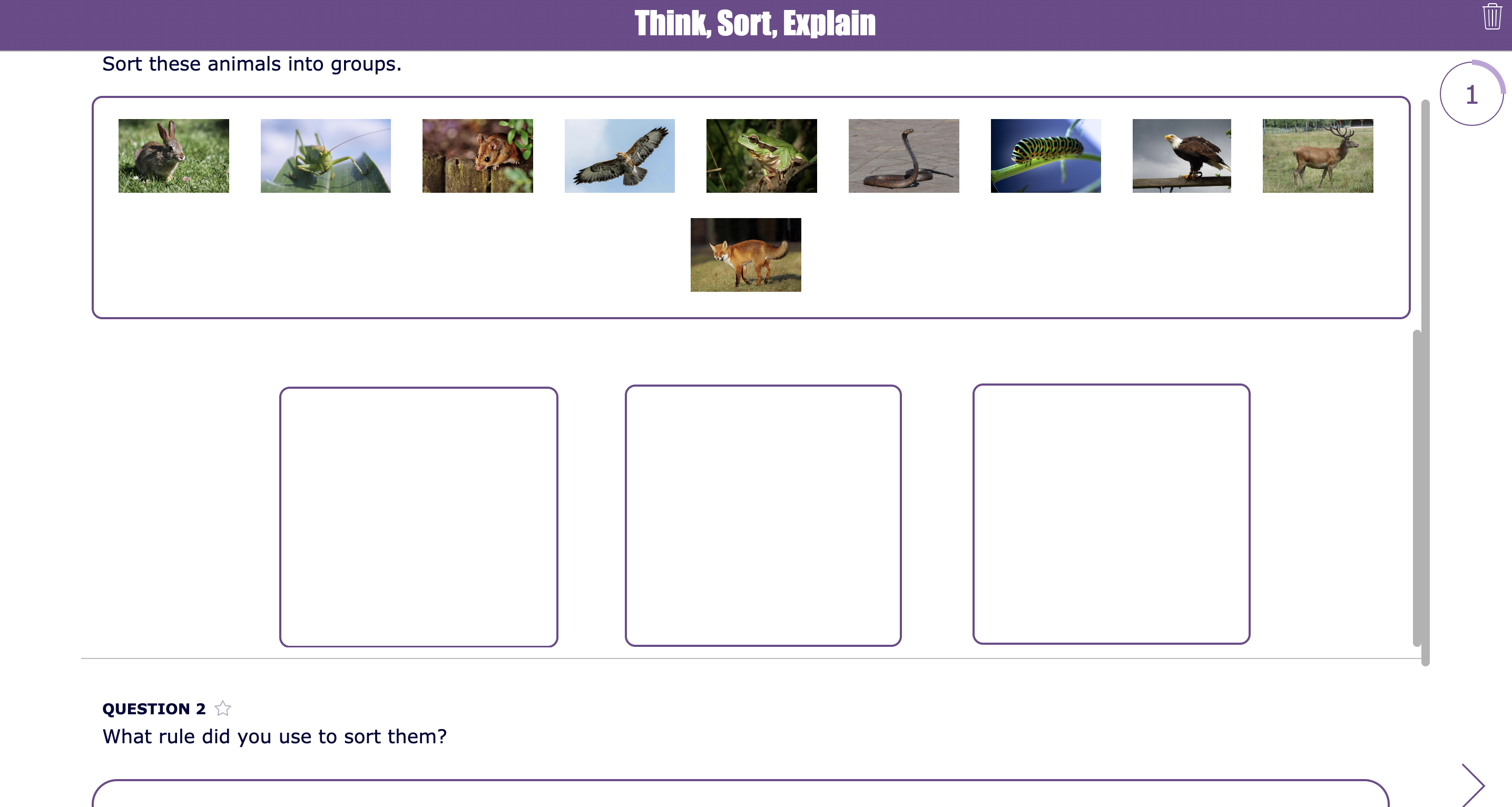
Students are given a set of items or ideas and have to decide how they should be grouped or classified. They then explain why they made those choices. The activity asks students to look for connections and think about how different ideas relate to each other. For teachers, it can also be a quick way to see how well students understand a topic and spot areas that may need some extra attention.
💡 BookWidgets Teacher tip: This activity is best reviewed manually rather than graded automatically. Students may place the groups in a different order than the one set in the widget. Their grouping can still be correct even if the order is different.
9. Beat the clock - William Shakespeare
| Icon | Area | Explanation |
|---|---|---|
| 🎓 | Subject & Grade | Geography - Primary School |
| 🎯 | Learning goal | Students recall and organize their prior knowledge about Shakespeare and make connections between related ideas. |
| 🧩 | BookWidgets widget type | Worksheet with a Mind Map |
| ⏱️ | Time needed | 5 minutes |
Students have a set amount of time to write down as much as they can remember about a topic. The time limit adds a little challenge and encourages students to get their ideas down without overthinking each answer. The activity helps students recall what they already know and gives teachers a quick sense of where the class is starting from.
💡 BookWidgets Teacher tip: In this activity, I used a timer that starts when students open the activity. Alternatively, you can use your own stopwatch and display it on a digital board so that everyone starts and finishes at the same time.

10. Problem of The Day
| Icon | Area | Explanation |
|---|---|---|
| 🎓 | Subject & Grade | Miscellaneous - All Grades |
| 🎯 | Learning goal | Students apply problem-solving skills to find and communicate a solution. |
| 🧩 | BookWidgets widget type | Quiz |
| ⏱️ | Time needed | 5 - 10 minutes |
A problem of the day gives students a chance to work through a question or challenge before the lesson begins. The teacher shares the problem with the whole class, so every student works on the same challenge before entering their solution in the widget.
The focus is not just on getting the right answer, but also on thinking through the problem and communicating how they arrived at a solution. The type of problem can vary depending on the subject, from a math calculation to a science question, logic puzzle, or real-world scenario.

11. Read Between the Lines
| Icon | Area | Explanation |
|---|---|---|
| 🎓 | Subject & Grade | History - High School |
| 🎯 | Learning goal | Students interpret a historical source and support an inference with evidence from the text. |
| 🧩 | BookWidgets widget type | Quiz |
| ⏱️ | Time needed | 5 - 10 minutes |
Reading a historical source is about more than identifying the facts that are written down. This activity asks students to look for clues, make an inference, and use evidence from the source to support their answer.
It encourages students to read more carefully and think about what a source can tell them beyond what is stated directly. For teachers, it also offers a quick way to see how students interpret historical information and use evidence to support their ideas.

12. Cause & Effect
| Icon | Area | Explanation |
|---|---|---|
| 🎓 | Subject & Grade | Economics - High School |
| 🎯 | Learning goal | Students analyze how changes in supply and demand can affect prices. |
| 🧩 | BookWidgets widget type | Whiteboard |
| ⏱️ | Time needed | 5 - 10 minutes |
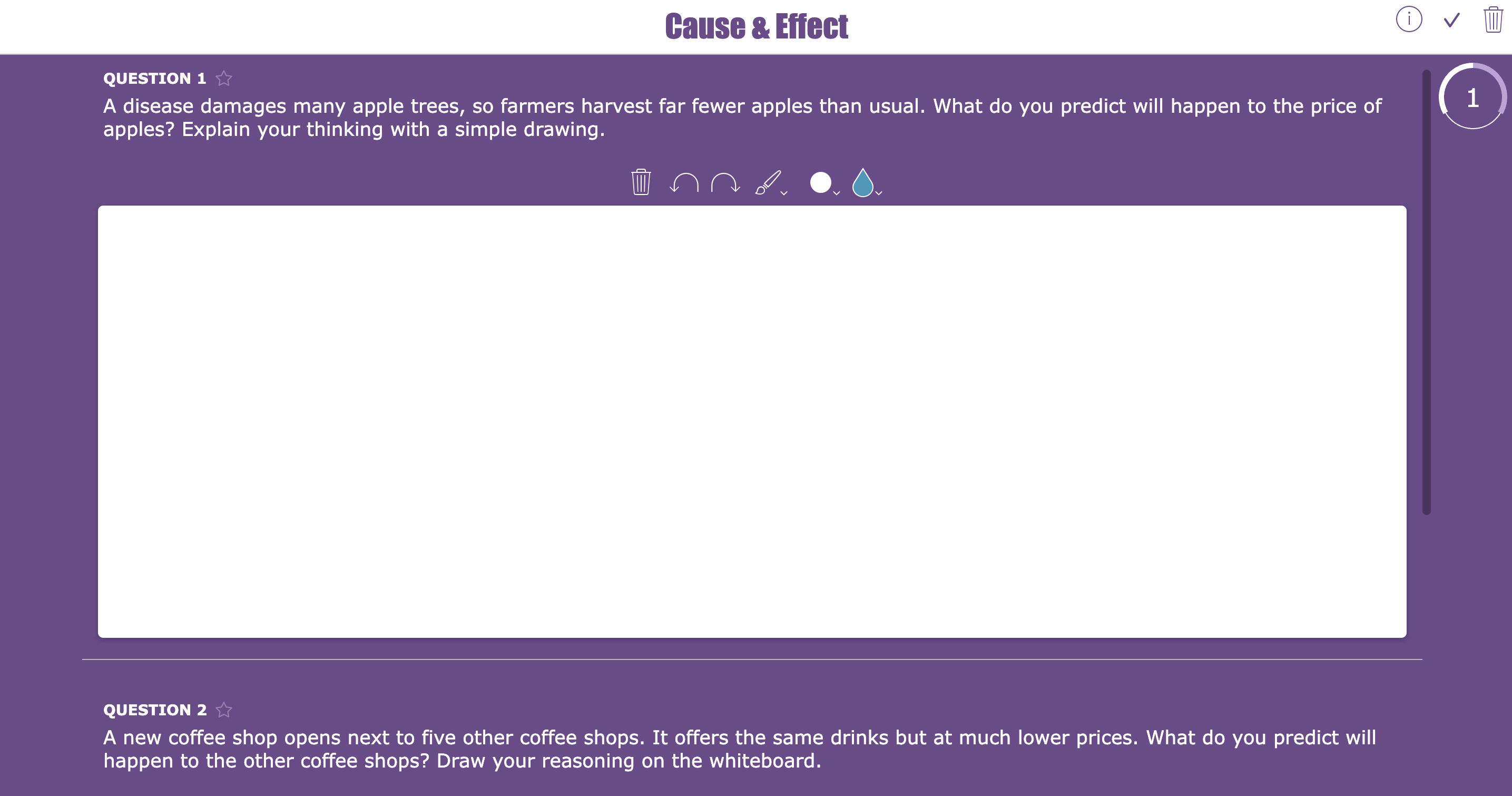
Understanding cause and effect helps students see how events, actions, or decisions can lead to different outcomes. This activity asks students to look at a scenario and identify the connection between what happened and what caused it.
You can add multiple scenarios to the question pool and enable randomized questions, so each student receives a different selection. For example, you could set the activity to give each student two random questions. This makes it less likely that students sitting next to each other will have the same questions, so they have to focus on their own scenario and work out their own answer.
💡 BookWidgets Teacher tip: Want to see how the randomized questions work? Open the example above and click the trash can icon in the top-right corner to get two new questions.
13. What I read
| Icon | Area | Explanation |
|---|---|---|
| 🎓 | Subject & Grade | Languages - Primary School |
| 🎯 | Learning goal | Students document what they have read and reflect on their thoughts about the text. |
| 🧩 | BookWidgets widget type | Quiz |
| ⏱️ | Time needed | 25 minutes |
This activity gives students a moment to slow down and reflect on what they have been reading. After 20 minutes of silent reading, they record the book title and author, note where they stopped and what was happening, and share their thoughts about what they read.
Because the content comes from the students’ own books, there’s no need to prepare new questions or change the activity for each class. The same structure can be used with different books and reading levels, while giving students a consistent way to document their reading and reflect on it.

14. Daily Affirmation
| Icon | Area | Explanation |
|---|---|---|
| 🎓 | Subject & Grade | SEL - Middle & High School |
| 🎯 | Learning goal | Students reflect on an affirmation and connect it to their own lives. |
| 🧩 | BookWidgets widget type | Split Worksheet with a Randomness Widget |
| ⏱️ | Time needed | 5 - 10 minutes |
A daily affirmation can work well as a bell ringer because it gives students a quiet moment to settle in and focus before the lesson starts. Students use the randomizer to receive an affirmation, then reflect on what it means to them, how it relates to who they are now, and how they could apply it to their experiences that day or in the future.
Since the activity isn't tied to a specific subject, it can fit naturally into the start of different lessons and give students a moment to focus on themselves before getting started.

15. Pre-Exam Readiness Check-In
| Icon | Area | Explanation |
|---|---|---|
| 🎓 | Subject & Grade | Miscellaneous - Middle & High School |
| 🎯 | Learning goal | Students reflect on their preparation and confidence to assess their readiness before an exam. |
| 🧩 | BookWidgets widget type | Quiz |
| ⏱️ | Time needed | 5 - 10 minutes |
Before an exam, a quick check-in can give students a moment to pause and think about how they are feeling and whether they feel ready to begin. This activity gives them a chance to reflect on their preparation and confidence before starting the exam.
Students use the rubric to check in with themselves and then answer an open-ended question with a helpful reminder or piece of advice for themselves. Their responses can also give teachers more insight into how students approach an exam. Looking back at these responses can help teachers understand what may have influenced a student's performance and how they can support the student before the next exam.
💡 BookWidgets Teacher tip: You can also adapt the questions and rubric to use this check-in before regular tests throughout the school year.

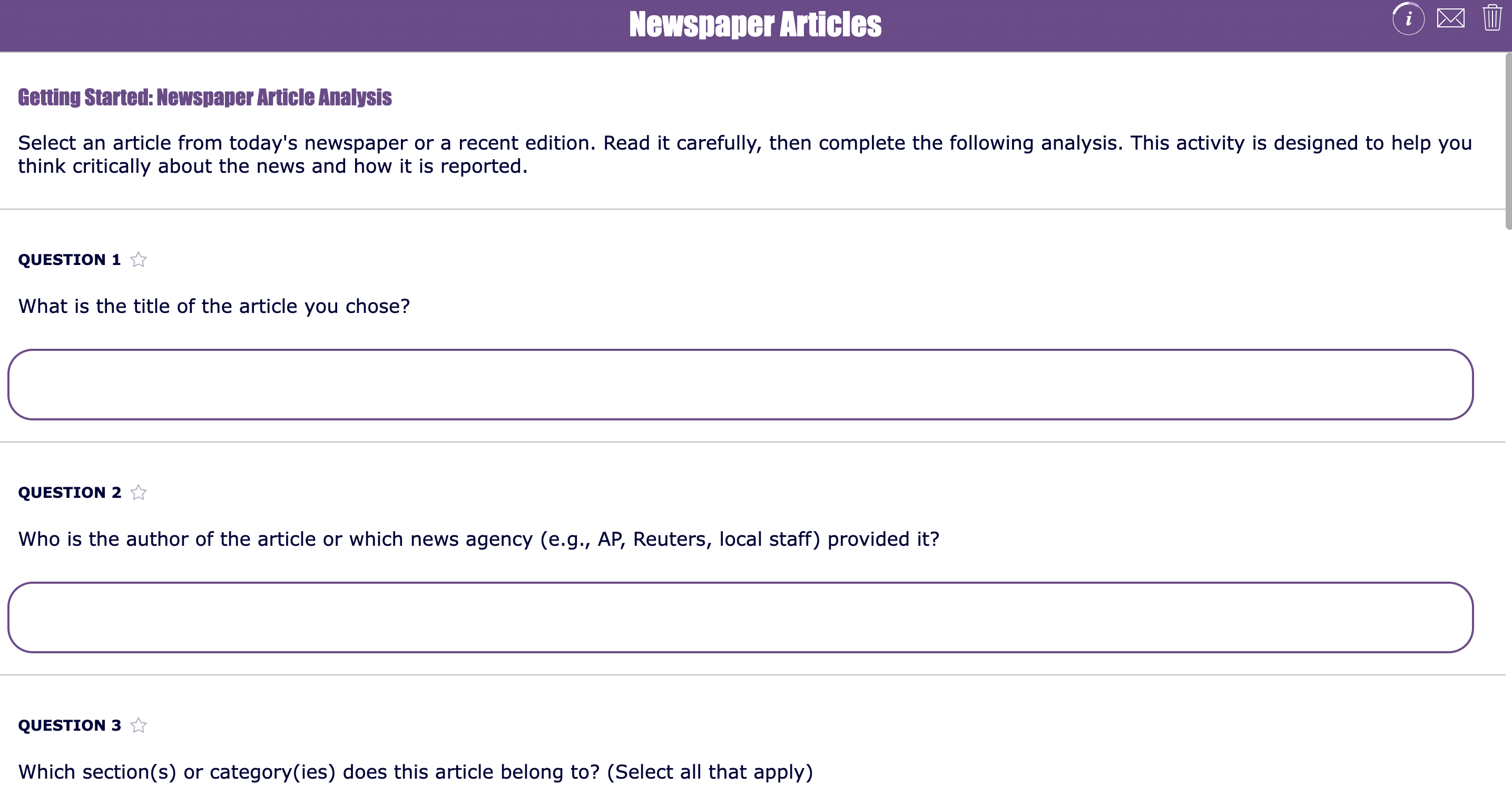
16. Reading Beyond the Headlines
| Icon | Area | Explanation |
|---|---|---|
| 🎓 | Subject & Grade | ELA, Histroy or Social Studies - Middle & High School |
| 🎯 | Learning goal | Students analyze a newspaper or magazine article, identify its key information and purpose, and reflect on what they have read. |
| 🧩 | BookWidgets widget type | Worksheet |
| ⏱️ | Time needed | 15 - 20 minutes |
Bringing real-world articles into the classroom gives students a chance to practise reading skills with texts that go beyond the textbook. This activity encourages students to look more closely at what they read and think about the message behind it. It also creates an opportunity to connect reading with current events and topics students may already be interested in.
Wrap Up
And that’s a wrap! Hopefully, these bell ringer ideas gave you a few new ways to make those first few minutes of class count. Whether you want to review previous learning, get students thinking, or give them a moment to reflect, there’s plenty of room to switch things up throughout the school year.
If you try one of the activities, we’d love to see it! Share your classroom experience with us on Facebook or Instagram.
The best part? You can create and adapt all of these activities yourself with BookWidgets to fit your own classroom.
I’m Chelsey from BookWidgets. If you enjoyed these ideas, come find me on LinkedIn. I’d love to connect! 👋


