Teaching Grammar in World Languages with these 10+ Ready-to-Use EdTech Lesson Ideas
 Dimitri Bongers —
Grammar is often perceived as one of the most challenging (and least exciting) parts of learning a new language. Whether students are working on French verb tenses, German cases, or Spanish sentence structure, they need repeated, meaningful practice to truly internalize patterns.
That’s where EdTech makes a real difference. With interactive tools like BookWidgets, grammar practice becomes active, visual, and personalized instead of repetitive and abstract. In this post, you’ll discover 10+ practical, ready-to-use activity ideas using BookWidgets widgets such as Quizzes, Worksheets, Flashcards, and Timelines. Perfect for world language classrooms.
What is BookWidgets?
If you're new to the platform, BookWidgets is an educational technology tool that allows teachers to easily create interactive digital exercises, assignments, and educational games for their students. Every single interactive activity you’ll see in this blog post was created using BookWidgets.
The best part? You don't have to build them from scratch! All of these examples are readily available in our dedicated BookWidgets blog group.
Want to use these activities with your students, or tweak the content to fit your specific lesson plan? Simply create a free BookWidgets account. Once signed up, you can easily duplicate, adapt, and share any of these widgets directly with your classroom.
Ready-to-use BookWidgets lessons in this post
Here’s an overview of the ready-to-use lesson ideas featured in this blog post. Click any of them to use them right away, or scroll down to explore each lesson in more detail, with practical tips, differentiation ideas, and examples in other languages. All of these examples are readily available in our dedicated BookWidgets blog group.
- 🇬🇧 ESL - Present Simple vs. Present Continuous (Digital Quiz)
- 🇬🇧 ESL - Prepositions (Interactive Quiz with instant feedback)
- 🇫🇷 FLE - Irregular past participles of French verbs (Flash cards)
- 🇫🇷 FLE - Verb conjugation in five common tenses (Timeline activity)
- 🇩🇪 DAF - Definite articles (Split Worksheet)
- 🇬🇧 English - They’re / Their / There (Video Quiz)
- 🇫🇷 FLE - Adjective agreement in spoken French (Audio Quiz)
- 🇬🇧 ESL - Irragular verb forms (Grammar Drill Rap Quiz)
- 🌎 Any language - Practise comparative structures (Before & After)
- 🇫🇷 FLE - French pronouns (Music Quiz)
- 🇪🇸 ELE - Spanish sentence construction (Randomness activity)
- 🇫🇷 FLE - The irregular verbs pouvoir and vouloir (WebQuest)
- 🇫🇷 FLE - Correct common French mistakes in Video Sketch (Split Worksheet)
Why teach grammar with EdTech?
Traditional grammar exercises often rely on static worksheets and repetitive drills. While these still have their place, they don’t always support engagement or long-term retention. Digital tools can enrich grammar instruction by making practice more interactive, contextual, and adaptable.
Using interactive digital tools helps you:
- Increase student engagement through active learning
- Provide immediate feedback (no waiting for correction)
- Differentiate instruction easily
- Track student progress in real time
- Encourage independent practice at home or in class
- Add rich context with videos, audio, images, texts, and other resources that help students understand how grammar is used in authentic situations
That said, digital tools are a means, not an end. Simply replacing a paper worksheet with a digital version offers little pedagogical added value. The real opportunity lies in designing learning activities that take advantage of what technology can do: providing instant feedback, creating interactive experiences, offering multimedia support, and adapting practice to students' needs.
Ready-to-use Grammar Lesson Ideas
1. Digital Worksheet: Guided grammar practice
| 🎓 | Subject & Grade | 🇬🇧 ESL, A1 |
| 🎯 | Learning goal | Master the difference between the Present Simple and the Present Continuous |
| ❓ | BookWidgets Widget type | Worksheet (or Quiz) |
| ⏱️ | Time needed | 10-15 minutes |
| 💡 | Lesson plan | Present grammatical concepts in a variety of ways, using a video and different types of questions. |
Pedagogical Value:
A BookWidgets Worksheet brings explanations, external resources, and interactive practice together in one structured activity. Instead of switching between different materials, students can learn a grammar concept and apply it immediately. In this example, students practise the difference between the Present Simple and Present Continuous using drag-and-drop noun phrases and fill-in-the-blank exercises. An embedded YouTube video introduces the topic. The result is an engaging, self-paced activity with instant feedback that reinforces learning.
BookWidgets ready-made lesson

🧠 Why it works:
- Combines instruction + practice in one place
- Supports scaffolding for mixed-ability groups
- Reduces cognitive overload
💡 BookWidgets Teacher tip:
Use the worksheet as a flipped learning activity: Students watch the video at home; so class time can focus on practice.
🚦Differentiation idea:
Create two versions of the same Worksheet: one with hints, one without.
Other examples:
- 🇬🇧 ESL - For vs. Since
- 🇬🇧 ESL - Present simple, Past simple, Present perfect simple
- 🇫🇷 FLE - La place de l'adjectif
2. Interactive Quiz: Grammar practice with instant feedback
| 🎓 | Subject & Grade | 🇬🇧 ESL, A2/B1 |
| 🎯 | Learning goal | Study and practice prepositions in English. |
| ❓ | BookWidgets Widget type | Quiz (with randomn question selection) |
| ⏱️ | Time needed | 15-20 minutes |
| 💡 | Lesson plan | Drill exercises with instant feedback, always presented in context |
Pedagogical Value
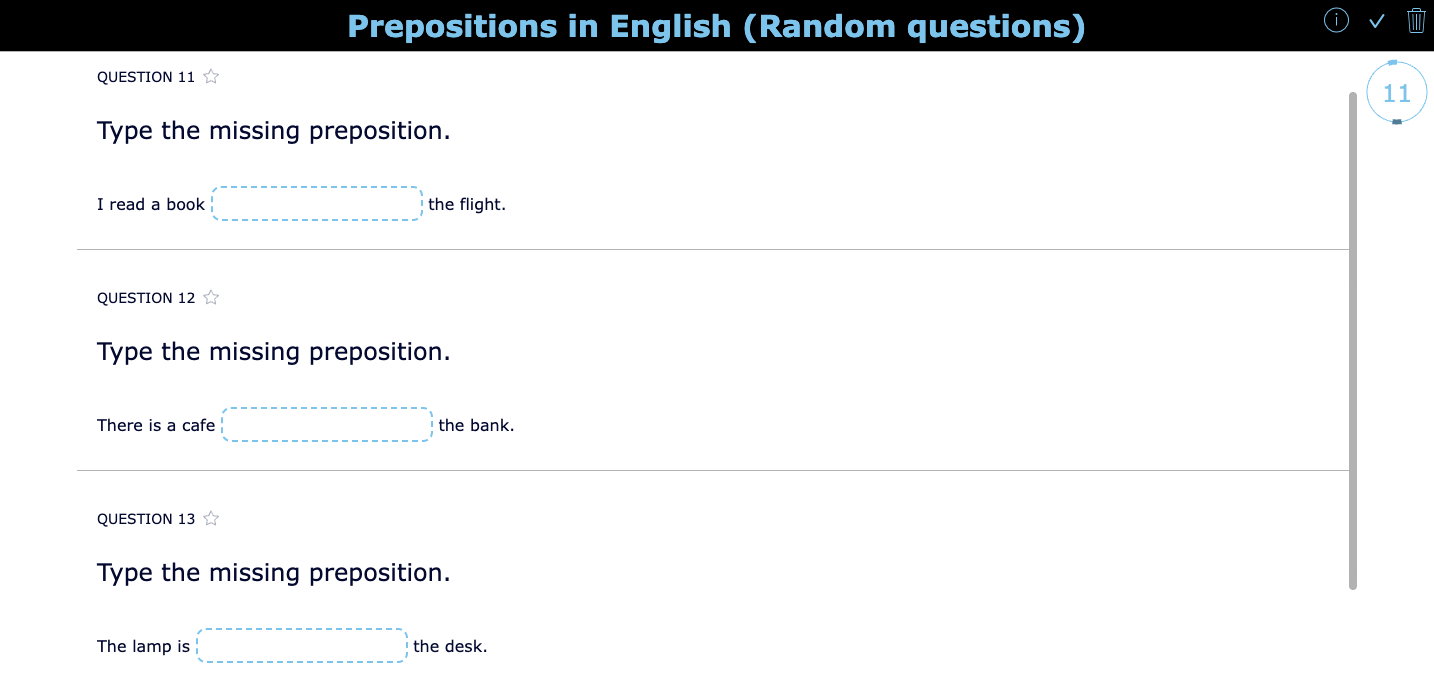
A BookWidgets Quiz helps students practise essential language knowledge through repeated practice and instant feedback. This makes it ideal for topics such as prepositions, where students need to memorise rules and common combinations.
In this example, students practise prepositions through short, focused exercises with questions randomly selected from a question bank. Each time they restart the quiz, they receive a new set of questions, encouraging repeated practice without simply memorising the answers. Instant feedback helps students identify mistakes and strengthen their knowledge in context.
BookWidgets ready-made lesson
🧠 Why it works:
- Encourages repeated retrieval practice
- Randomised questions keep every attempt meaningful
- Instant feedback strengthens long-term retention
💡 BookWidgets Teacher tip: Add explanation feedback for each answer so students understand why a preposition is correct, not just whether it is correct.
🚦Differentiation idea:
Create two versions of the same Quiz: one with hints, one without.
Other examples:
- 🇫🇷 FLE - Les prépositions
- 🇩🇪 DAF - Die artikel (Nominativ - Akkusativ - Dativ)
- 🇪🇸 ELE - El pretérito perfecto
3. Flashcards: Grammar recall
| 🎓 | Subject & Grade | 🇫🇷 French (FLE), A2/B1 |
| 🎯 | Learning goal | Students memorize and recall the irregular past participles of common French verbs. |
| ❓ | BookWidgets Widget type | Flash cards |
| ⏱️ | Time needed | 10-15 minutes |
| 💡 | Activity idea | Students study and practise irregular past participles using flash cards. |
Pedagogical Value
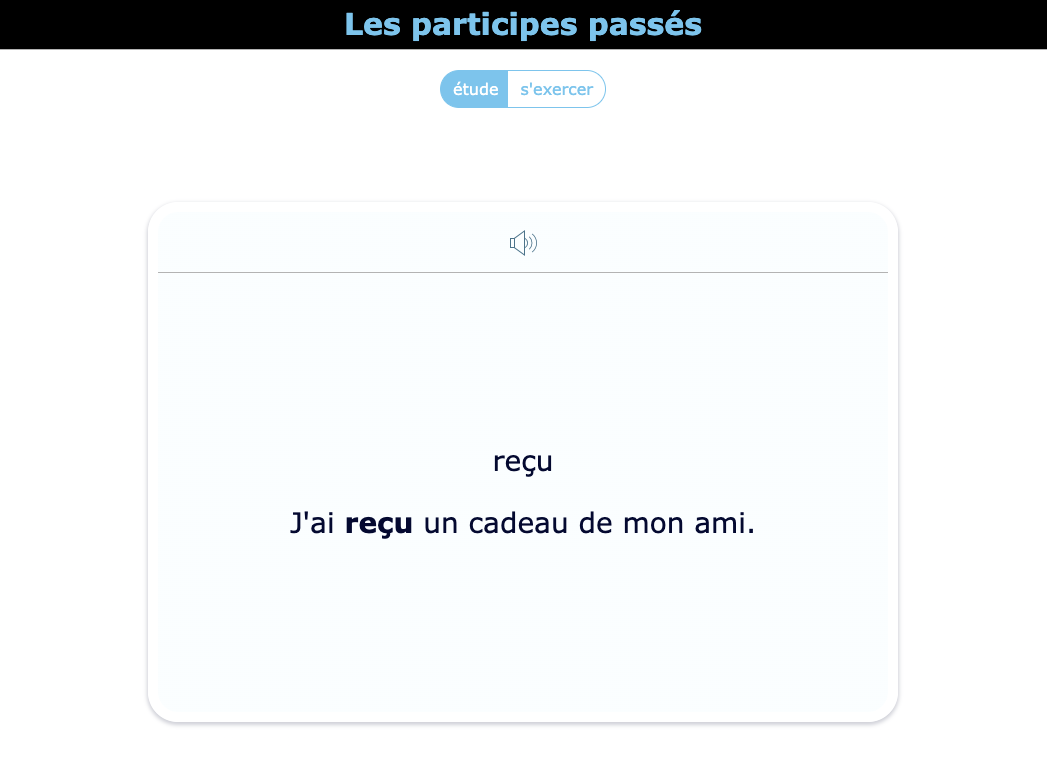
BookWidgets Flash Cards help students memorise and recall essential grammar forms through repeated retrieval practice. They are particularly useful for grammar that involves forms students need to know automatically, such as irregular verb forms, verb endings, gender, articles, or common grammatical patterns.
As this example shows, teachers can add even more value to Flash Cards by providing example sentences that show the grammatical forms in context, as well as audio so students can listen to and practise the correct pronunciation.
BookWidgets ready-made lesson
🧠 Why it works:
- Encourages active recall of grammatical forms
- Helps students memorise irregular or unpredictable patterns
- Makes repeated practice quick and focused
- Builds automaticity that supports more fluent language production
💡 BookWidgets Teacher tip:
Assign flashcards as “warm-up” or “exit ticket” activities.
🚦Differenciation idea:
For students who need more support, let them practise a smaller selection of cards or repeat the activity at their own pace. For faster students, ask them to create their own sentences using the irregular past participles, helping them move from memorising forms to using them in context.
Other examples:
4. Timeline activity: Mastering verb tenses in context
| 🎓 | Subject & Grade | 🇫🇷 French (FLE), A2 |
| 🎯 | Learning goal | Students practise French verb conjugation in five common tenses and distinguish between different time frames. |
| ❓ | BookWidgets Widget type | Timeline |
| ⏱️ | Time needed | 5-10 minutes |
| 💡 | Activity idea | Students build sentences with the correct form of a verb in the passé composé, passé récent, présent de l’indicatif, futur proche and futur simple, and place them in the correct chronological position on a timeline. |
Pedagogical Value
BookWidgets' Timeline helps students understand and practise how different verb tenses relate to time. It is particularly useful for language learning, where students need to recognise not only how a verb is formed, but also which tense is appropriate for a particular time frame or situation.
By building sentences and placing them on a timeline, students connect the grammatical form to its meaning and position in time. This provides a visual way to distinguish between past, present and future forms while reinforcing the correct conjugation of the verb.
BookWidgets ready-made lesson

🧠 Why it works:
- Connects grammatical forms to a clear visual representation of time
- Helps students distinguish between different verb tenses
- Encourages students to apply conjugation rules in meaningful sentences
- Reinforces both form and meaning through contextualised practice
💡 BookWidgets Teacher tip:
Use the Timeline as a review activity after introducing several tenses. Ask students to explain why each sentence belongs in a particular position on the timeline, encouraging them to focus on meaning as well as grammatical form.
🚦Differentiation idea:
Add clear instructions to guide students who need more support. For faster students, add more sentences to the Timeline or challenge them to create a short story using lire in the different tenses.
Other example
5. Split Worksheet: Combining grammar Theory and Practice
| 🎓 | Subject & Grade | 🇩🇪 German (DaF), A2 |
| 🎯 | Learning goal | Students understand and practise the use of definite articles (der, die, das, den, dem, des) in different grammatical cases. |
| ❓ | BookWidgets Widget type | Split Worksheet |
| ⏱️ | Time needed | 15–20 minutes |
| 💡 | Activity idea | Students first review explanations about German definite articles in the nominative, accusative, dative and genitive cases using text and video resources. They then complete exercises while being able to quickly consult the relevant resources whenever they need support. |
Pedagogical Value
BookWidgets' Split Worksheet combines learning resources and practice in one activity. This makes it particularly useful when students are encountering new grammar and need to move between explanation and application.
In this example, students learn about German definite articles in different cases through a combination of text and video explanations. They can then immediately apply what they have learned in targeted exercises while keeping the explanations accessible on the other side of the worksheet. This allows students to review the theory whenever they are unsure, supporting independent learning and helping them connect grammatical rules to practical examples.
BookWidgets ready-made lesson

🧠 Why it works:
- Combines explanation and practice in one activity
- Gives students immediate access to learning resources while practising
- Supports students in becoming more independent learners
- Combines different media formats to explain new grammar
- Makes it easy for students to review and apply grammatical rules
💡 BookWidgets Teacher tip:
Use a Split Worksheet when introducing new grammar that students need to apply immediately. Keep the explanations concise and provide examples that directly correspond to the exercises so students can easily use the resources as a reference.
🚦Differentiation idea:
Provide more detailed explanations and additional examples for students who need extra support. For faster students, add more challenging exercises or ask them to create their own sentences using the different cases and definite articles.
6. Video Quiz: Exploring Grammar through Video
| 🎓 | Subject & Grade | 🇬🇧 English (native speakers), grades 5–8 |
| 🎯 | Learning goal | Students understand the difference between they’re, their and there and use each form correctly in context. |
| ❓ | BookWidgets Widget type | Video Quiz |
| ⏱️ | Time needed | 10-15 minutes |
| 💡 | Activity idea | Ask students to write a short argument paragraph answering a historical question. |
Pedagogical Value
BookWidgets' Video Quiz combines multimedia input with active practice, making it useful for language learning. Instead of passively watching an explanation, students interact with the content and immediately apply what they have learned.
In this example, students learn to distinguish between the commonly confused forms they’re, their and there. Questions embedded throughout the video prompt students to identify the correct form in context, helping them connect the grammatical rule to authentic language use. Immediate feedback allows students to recognise and correct misunderstandings while the concept is still fresh.
BookWidgets ready-made lesson

🧠 Why it works:
- Combines visual and auditory input with active practice
- Breaks a video into smaller, interactive learning moments
- Helps students apply grammar rules in context
- Immediate feedback reinforces correct usage
- Keeps students actively engaged while watching
💡 BookWidgets Teacher tip:
Use the Video Quiz to introduce or review grammar points that are easy to confuse. Place questions immediately after the relevant explanation so students can check whether they have understood the concept before moving on.
🚦Differentiation idea:
Allow students who need more support to rewind the video and review the explanation as often as needed. For stronger students, disable rewinding so they have to rely on their understanding and recall.
7. Audio Worksheet: Practise grammar through speaking
| 🎓 | Subject & Grade | 🇫🇷 FLE, A2 |
| 🎯 | Learning goal | Students practise adjective agreement and apply the correct forms in spoken French. |
| ❓ | BookWidgets Widget type | Worksheet with Audio Questions |
| ⏱️ | Time needed | 10 minutes |
| 💡 | Activity idea | Complete sentences by choosing the correct adjective form, then record the full sentence and compare it with the model answer. |
Pedagogical value
Grammar practice often focuses heavily on written language, while much of our everyday communication happens through speaking. A BookWidgets Worksheet with Audio Questions bridges this gap by asking students to apply grammar while actually speaking. This helps them move beyond knowing a grammar rule to using it naturally when speaking.
In this example, students choose the correct adjective form and record the complete sentence. They can immediately listen to a model answer and compare their own pronunciation. Teachers can also review the recordings afterwards and provide individual audio feedback, making the activity useful for both independent practice and targeted speaking support.
BookWidgets ready-made lesson

🧠 Why it works:
- Combines grammar practice with active speaking
- Helps students connect written grammar to spoken language
- Gives students an immediate model for comparison
- Allows teachers to provide personalised audio feedback
💡 BookWidgets Teacher tip:
Speaking out loud in a full classroom can be very intimidating for A2 students. Assign this widget as homework so they can practice in a safe, quiet environment. This way, they can compare their recording with the model answer and retry as often as they like until they feel confident. If you do use it in class, make sure they wear headsets with a built-in microphone!
🚦Differentiation idea:
The Bloc-note gives students who need extra support a space to write down the correct answer before recording it. For stronger students, turn off the Bloc-note or challenge them to create and record an additional sentence using the same adjective.
8. Grammar Drill Rap Quiz: Practising Grammar one beat at a time
| 🎓 | Subject & Grade | 🇬🇧 ESL, A2/B1 |
| 🎯 | Learning goal | Students practise and memorise irregular verb forms through repeated listening, retrieval and spoken production. |
| ❓ | BookWidgets Widget type | Split Worksheet |
| ⏱️ | Time needed | 10 minutes |
| 💡 | Activity idea | Students watch a short rap video before practising irregular verbs. |
Pedagogical value
Sometimes, drill practice is necessary; especially for tricky topics like irregular verbs. But who says drills have to be boring? Some teachers have turned these forms into catchy rap songs, giving “drill rap” a whole new meaning.
In this Worksheet, students can watch a short clip of a rap that practices the target language, then answer questions. You can also turn it into a creative production activity: students take an existing rhythm and compose their own “language drill rap”, reinforcing grammar while engaging with rhythm, rhyme, and performance.
BookWidgets ready-made lesson

🧠 Why it works:
- Makes repetitive drill practice more engaging and memorable
- Encourages repeated retrieval of irregular forms
- Combines listening, reading and speaking practice
- Gives students opportunities to practise language in a rhythmic and meaningful way
- Creative production encourages students to actively use and manipulate the target language
💡 BookWidgets Teacher tip:
Start with a short, catchy rap containing the target language. Gradually make the activity more active by removing words and asking students to complete the missing forms.
🚦Differentiation idea:
Allow students who need more support to replay the rap and use the complete lyrics as a reference. For stronger students, remove more of the written support or challenge them to create and perform their own drill rap using a set of target verbs.
Other example
9. Before & After: learning comparative and superlative forms
| 🎓 | Subject & Grade | 🌎 Foreign Language Learning, A2/B1 |
| 🎯 | Learning goal | Students practise comparative structures and use past and present tenses to describe how a place or situation has changed over time. |
| ❓ | BookWidgets Widget type | Before & After |
| ⏱️ | Time needed | 10-15 minutes |
| 💡 | Activity idea | Students compare two images of the same place taken at different points in time. They describe what has changed, using comparative structures and a combination of past and present tenses. |
Pedagogical Value
BookWidgets' Before & After widget provides a simple visual prompt that encourages students to use language in a meaningful context. Because the widget does not contain any language-specific text, it can be used across different languages and adapted to a wide range of language-learning activities.
In this example, students compare two images of the same square in Antwerp taken ten years apart. They describe the changes they can see, using comparative structures and a combination of past and present tenses. Instead of practising grammar through isolated sentences, students use the target language to communicate about a meaningful visual context. This makes the activity particularly effective as a prompt for speaking practice.
In this example, the interactive exercise is a resource that students use during a speaking exercise. In the Before & After widget, they see two pictures of the same square in Antwerp, Belgium. The square has changed a lot in 10 years.
Students explain these changes, using comparative structures and a mix of past and present tenses to describe the transformation. This is a powerful example of context-based grammar practice using visual prompts. By integrating interactive images in BookWidgets, you turn grammar practice into an engaging speaking activity.
BookWidgets ready-made lesson

🧠 Why it works:
- Provides a clear visual context for language production
- Encourages students to use grammar meaningfully rather than in isolated sentences
- Combines comparative structures with past and present tenses
- Supports speaking activities without requiring extensive written preparation
- Can be used across different languages and adapted to many topics
💡 BookWidgets Teacher tip:
Use images that show a clear transformation over time and ask students to describe as many changes as possible. Encourage them to use specific comparative structures such as bigger than, more modern than or their equivalents in the target language.
🚦Differentiation idea:
For students who need more support, provide a short list of useful vocabulary or sentence starters they can use while comparing the images. For stronger students, ask them to make more detailed comparisons, explain why the changes may have happened, or describe what the place might look like in the future.
10. Music Quiz: Exploring Grammar through Song Lyrics
| 🎓 | Subject & Grade | 🇫🇷 French, A2/B1 |
| 🎯 | Learning goal | Students practise identifying and using pronouns in authentic spoken French. |
| ❓ | BookWidgets Widget type | Split Worksheet |
| ⏱️ | Time needed | 10-15 minutes |
| 💡 | Activity idea | Listen to an authentic French song and complete the missing pronouns while listening. |
Pedagogical Value
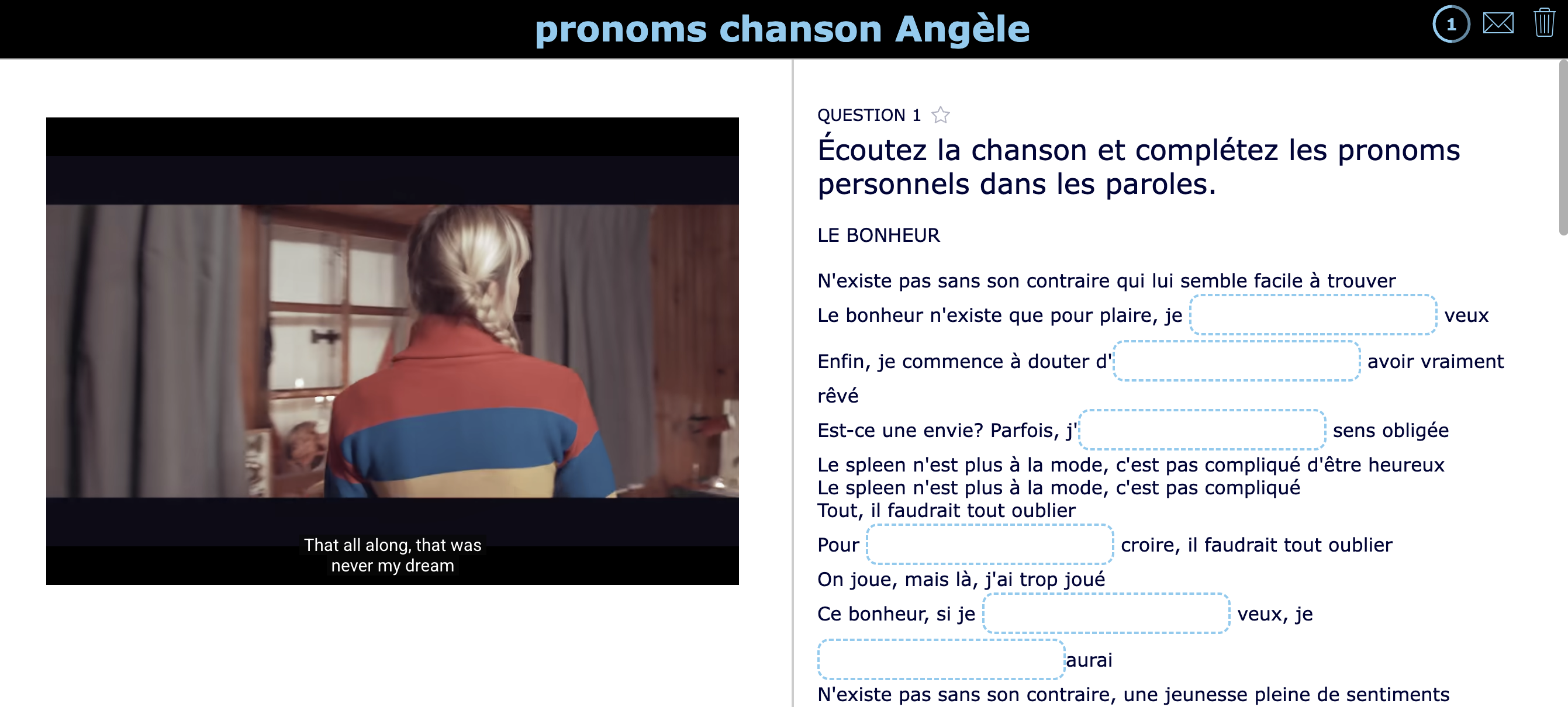
A BookWidgets Split Worksheet allows to combines authentic listening material with active language practice. Instead of simply listening to a song, students have to pay attention to the language while listening.
In this example, students watch an embedded YouTube video of a French song and fill in the missing pronouns as they listen. The same approach can be used to practise other language elements, such as prepositions or verbs. This makes listening practice more engaging while helping students notice and understand language in an authentic context.
BookWidgets ready-made lesson
🧠 Why it works:
- Turns passive listening into active language practice
- Uses authentic language in a meaningful context
- Helps students notice specific grammar and vocabulary in context
💡 BookWidgets Teacher tip:
Choose a song that matches your students' level and focus on one specific language element.
🚦Differentiation idea:
Create different versions of the same activity by changing the number of gaps. Leave more words visible for students who need support, and remove more words for students who need an extra challenge.
11. Randomness activity: practising grammar with random prompts
| 🎓 | Subject & Grade | 🇪🇸 Spanish, A2/B1 |
| 🎯 | Learning goal | Students apply grammar rules to construct correct sentences in Spanish. |
| ❓ | BookWidgets Widget type | Randomness |
| ⏱️ | Time needed | 10–15 minutes |
| 💡 | Activity idea | Challenge students to build grammatically correct sentences from randomly selected elements. |
Pedagogical Value:
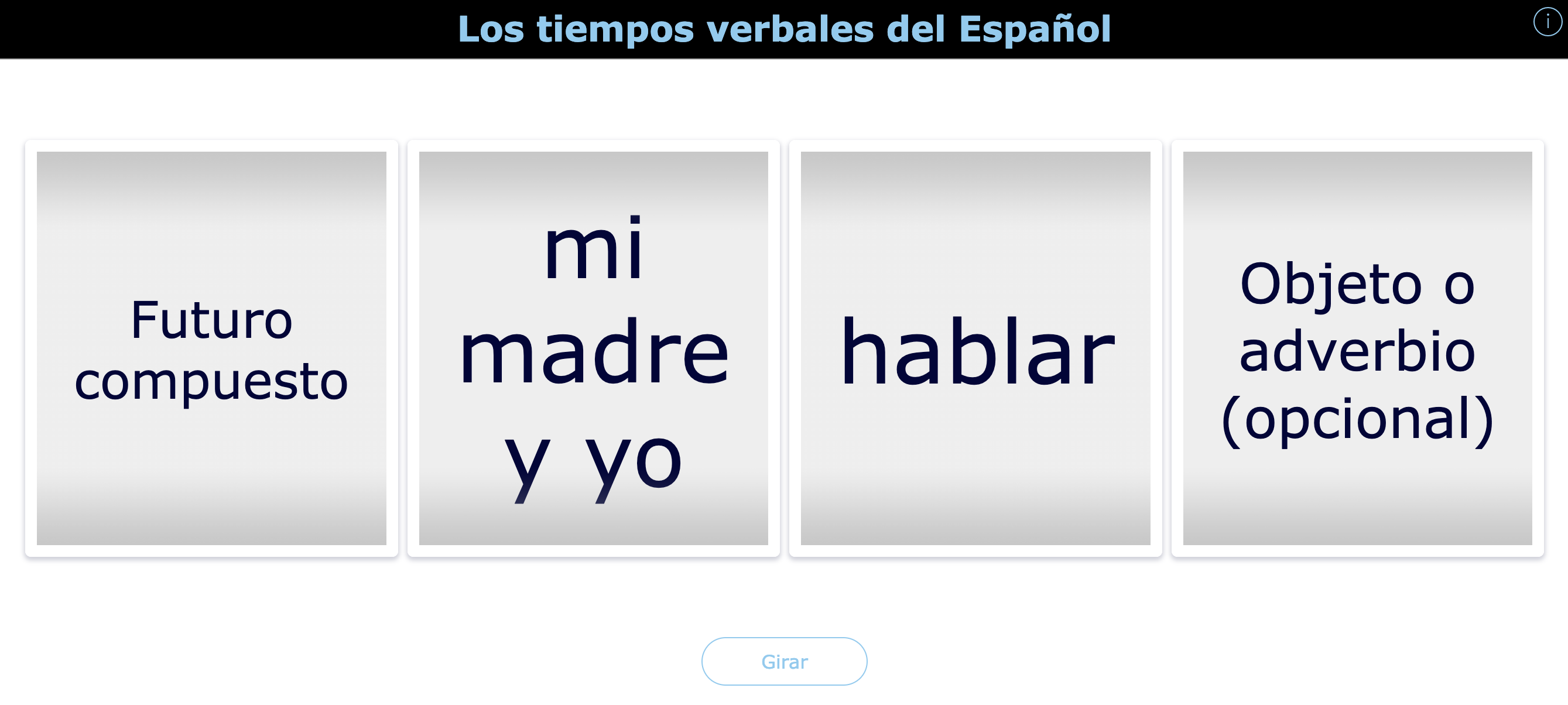
A BookWidgets Randomness widget moves grammar practice beyond recognising the correct answer and asks students to actively apply what they have learned. By combining randomly selected elements, students have to retrieve grammar rules and use them to construct a meaningful sentence.
BookWidgets ready-made lesson:
🧠 Why it works:
- Requires students to actively produce language
- Tests whether students can apply grammar in context
- Random combinations make every attempt different
- Encourages flexible use of grammar rather than memorisation
💡 BookWidgets Teacher tip:
Use the activity as a quick speaking exercise. After creating their sentence, ask students to say it aloud. Then, the student may choose who goes next.
🚦Differenciation idea
Provide fewer or more elements depending on students' level. For additional support, include a verb and subject; for a greater challenge, add extra elements such as time expressions, adjectives, or a second clause.
Other examples:
12. WebQuest: exploring grammar through a guided learning path
| 🎓 | Subject & Grade | 🇫🇷 French, A2/B1 |
| 🎯 | Learning goal | Students discover and practise the conjugation, pronunciation, and use of the irregular verbs pouvoir and vouloir. |
| ❓ | BookWidgets Widget type | WebQuest |
| ⏱️ | Time needed | +1 hour |
| 💡 | Activity idea | Guide students through a variety of activities and resources to discover, practise, and apply two common irregular French verbs. |
Pedagogical Value
A BookWidgets WebQuest allows teachers to turn grammar practice into a structured learning journey. Instead of presenting grammar rules upfront, students discover the conjugation, pronunciation, and use of pouvoir and vouloir through a variety of activities and authentic resources.
In this example, the WebQuest combines (Split) Worksheets, Flash Cards, and a Randomness widget with external resources and music featuring the target verbs. This variety allows students to encounter the same grammar in different ways, moving from discovery and understanding to practice and application. The structured sequence also helps students build their knowledge step by step.
This example shows how to use a WebQuest to teach grammar elements (like irregular verbs) in context.
BookWidgets ready-made lesson:

🧠 Wy it works:
- Encourages inductive learning and active discovery
- Presents grammar through multiple formats and contexts
- Builds a structured learning path from discovery to practice
- Connects grammar to authentic cultural resources
💡 BookWidgets Teacher tip:
Think of a WebQuest as a learning path rather than a collection of exercises. Start with discovery, then gradually move towards guided practice and independent application.
🚦Differentiation idea:
Create different paths through the WebQuest. Provide additional hints, explanations, or simpler activities for students who need more support, while offering extension activities or more open-ended production tasks to stronger students.
13. Video Grammar Challenge: Spot and correct common mistakes
| 🎓 | Subject & Grade | 🇫🇷 French, B2+ |
| 🎯 | Learning goal | Identify and correct common grammatical errors in authentic-sounding French |
| ❓ | BookWidgets Widget type | Split Worksheet |
| ⏱️ | Time needed | 10-15 minutes |
| 💡 | Lesson plan | Watch a humorous movie trailer packed with common French grammar mistakes, then identify and correct the errors in the dialogue. |
Pedagogical Value:
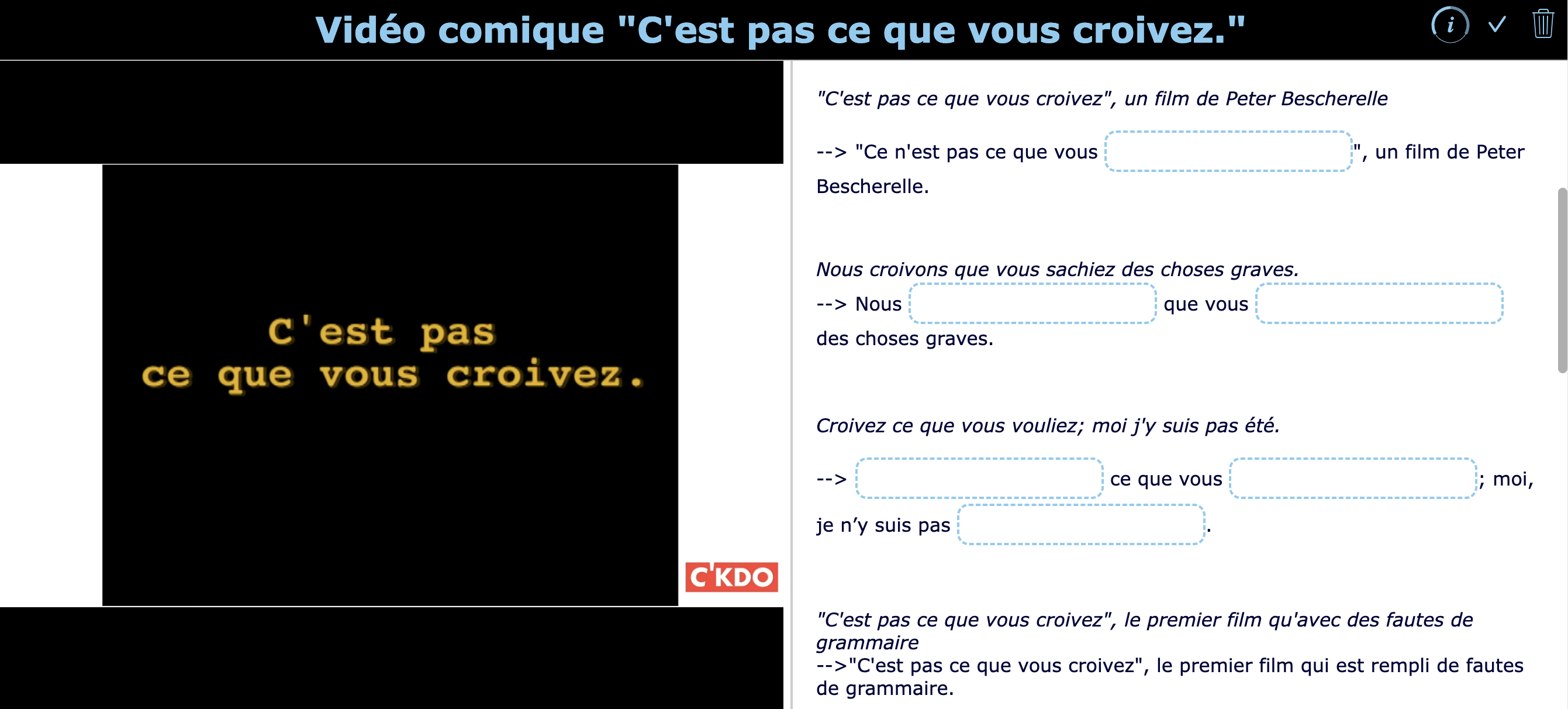
This activity challenges advanced learners to use their grammatical knowledge in context. Students watch a humorous sketch presented as the trailer for a fictional French movie, deliberately filled with common grammar mistakes. They then have to spot the errors and correct them, requiring them to draw on their language awareness rather than simply recall grammar rules. This makes the activity particularly suitable for strong B2+ students who are ready for a more demanding challenge.
BookWidgets ready-made lesson
🧠 Why it works:
- Turns grammar correction into a fun, contextual challenge
- Develops students’ grammatical awareness and attention to detail
- Encourages learners to explain and apply grammar rules rather than simply memorise them
💡 BookWidgets Teacher tip:
Use this activity as an extension task for stronger students who finish their regular exercises early. While other students continue practising the target grammar, advanced learners can work independently on the video challenge and then compare their corrections with a partner.
🚦Differentiation idea:
Challenge students to identify not only the incorrect forms, but also explain why each correction is needed. For an extra challenge, ask them to classify the mistakes by grammatical topic, such as verb conjugation, pronouns, agreement, or sentence structure.
Additional Resources for teaching languages
You've already seen numerous examples of interactive online grammar exercises in this blog post, but there's more!
BookWidgets has an active community of teachers who share their ready-made exercises. For World Languages, check out the following groups:
- 🇬🇧 Teaching English
- 🇫🇷 Enseigner le français langue étrangère (FLE)
- 🇩🇪 DaF (Deutsch als Fremdsprache)
- 🇪🇸 Español Lengua Extranjera
- 🇮🇹 Italiano L2/LS
Learn more about collaborating in BookWidgets groups by watching this recorded webinar.
And finally, check out our previous blog posts:
- 25 Creative Ideas To Make Your Students Fall In Love With Learning Languages
- 10+ Creative and Fun Lesson Ideas for the World Language Classroom
- 7 creative ways to teach languages
- 30+ Ready-to-Use French Lesson Ideas to Boost Classroom Engagement
- 25+ free and ready-to-use Spanish lesson activities for a fun ELE class
- 30 interaktive Übungen und Spiele für den DaF-Unterricht – sofort einsetzbar
How to use these BookWidgets activities in your classroom
Above, you’ll find 10+ ready-to-use grammar lesson activities. Simply click on an image to open the activity and try it out for free. Since all of these activities were created with BookWidgets, you can also find them together in this BookWidgets group.
Want to use one of these activities with your own students? Here’s how:
- Open the grammar activities. Click on this link to go directly to the group containing all the grammar activities. If you don’t have a BookWidgets account yet, you’ll need to sign up for free first.
- Choose and duplicate an activity. Open the folder with the grammar activity you’d like to use. Click the three dots icon and select Duplicate selected widgets. Then, choose where you’d like to save the activity in your BookWidgets account.
- Customize the activity. Go to your saved grammar lessons. Click the black dropdown arrow next to the Show button and select Edit. You can now make any changes you’d like to the activity. Once you’re happy with it, click Share in the top-right corner.
- Share it with your students. Share the link with your students. They can open the activity, complete it, and submit their answers to you by clicking the Submit button.
- Review your students’ answers. As a teacher, go to Review in BookWidgets to see your students’ submissions and answers.
And that’s it! Now that you have your own BookWidgets account, you can also create your own language activities, quizzes, assignments, and much more.
Please note: Once your free trial ends, you’ll still be able to use the widgets you’ve already created and shared with students. Your BookWidgets account will continue to work, and you’ll still be able to receive and review your students’ results with the free version. However, you’ll no longer be able to duplicate existing widgets or create new ones yourself.
Wrap-up
Teaching grammar in world languages doesn’t have to rely on repetitive worksheets. With BookWidgets, you can turn grammar practice into interactive, visual, and student-centered learning experiences.
From quizzes and worksheets to flashcards and timelines, you can build a complete grammar learning journey that helps students practise, understand, and apply grammar in meaningful ways.
👉 Ready to bring your grammar lessons to life? Try adapting one of these activities for your next lesson and see how your students respond.
💡 Have a grammar activity or BookWidgets idea of your own? Share your examples and experiences with other teachers in our Teaching with BookWidgets Facebook group. We’d love to see what you’ve created!


