
8 Creative SDG 14 Lesson Plans for Teaching Life Below Water
 Lucie Renard —
SDG 14, Life Below Water, focuses on conserving and sustainably using the oceans, seas, and marine resources. The goal covers important classroom topics such as marine pollution, plastic waste, overfishing, ocean acidification, coral reefs, protected marine areas, and the role humans play in protecting ocean life.
For teachers, SDG 14 is a powerful topic because students can connect global ocean challenges to everyday choices: the food they eat, the plastic they use, the products they buy, and the actions they can take at school or at home.
💡 With BookWidgets, you can turn SDG 14 into interactive digital lessons students can complete individually, in pairs, or as part of a project. Use the lesson ideas below as ready-to-use templates you can copy, adapt, and share through Google Classroom, Microsoft Teams, Canvas, Moodle, or another LMS. You can find them together in this free BookWidgets group on SDGs.
Make sure to keep an eye on more SDG lesson resources below— we publish a new post with ready-to-use SDG activities each month!
Now, let's get started with these sustainability teaching resources!
Ready-to-use BookWidgets lessons in this post
This post includes 8 free and interactive BookWidgets lesson activities for teaching SDG 14: Life Below Water. The activities are designed for different grade levels, from kindergarten and primary school to middle and high school. Teachers can copy, adapt, and share each activity with students through their LMS.
- Start with this Life Below Water Video Quiz for primary school students
Introduce students to the meaning of SDG 14 with an interactive video quiz about oceans, marine life, and why life below water needs protection. - Explore The Plastic Problem Split Worksheet for middle school students
Help students understand how plastic pollution affects oceans, sea animals, and human communities. - Use this SDG 14 terminology Word Search for high school students
Let students review important SDG 14 vocabulary in a low-pressure, interactive way. - Review ocean pollution with this BookWidgets Crossword Puzzle for middle school students
Reinforce key terms and concepts about ocean pollution through a vocabulary-based puzzle. - Discover whale sharks with this interactive BookWidgets Worksheet
Students explore whale sharks using a video, 3D model, and trivia flashcards while learning why marine species need protection. - Investigate coral reefs with this ready-to-use BookWidgets WebQuest
Guide high school students through a research-based lesson about coral reefs, threats, and possible conservation solutions. - Introduce young learners to SDG 14 with Plink Goes to the Sea
Use this story-based Split Worksheet to help first-grade students talk about the sea, sea animals, and keeping water clean. - Start an ocean conversation with this SDG 14 Jigsaw Puzzle
Let kindergarten students and toddlers complete an ocean-themed puzzle and discuss what they see in the image.
What is SDG 14: Life Below Water?
SDG 14: Life Below Water is one of the 17 Sustainable Development Goals created by the United Nations. Its official goal is to conserve and sustainably use the oceans, seas, and marine resources for sustainable development.
In simple terms, SDG 14 is about protecting oceans and marine life. It focuses on keeping seas, coasts, and underwater ecosystems healthy so they can continue supporting people, animals, and the planet.
This goal includes topics such as:
- marine pollution and plastic waste;
- coral reefs and coastal ecosystems;
- ocean acidification;
- marine biodiversity;
- overfishing and illegal fishing;
- sustainable use of ocean resources.
For students, SDG 14 can be explained like this: SDG 14: Life Below Water is a global goal that asks people, governments, and organizations to protect oceans and marine life. It focuses on reducing pollution, protecting sea animals and habitats, stopping overfishing, and using ocean resources responsibly so oceans stay healthy for future generations.
Why Should Teachers Include SDG 14 in Their Lessons?
Teaching SDG 14 helps students understand why healthy oceans matter and how human choices affect life below water. It turns a global sustainability goal into a topic students can investigate, discuss, and connect to real life.
SDG 14 is especially useful in the classroom because it encourages students to think critically about cause and effect. For example, they can explore how plastic waste travels from land to sea, how overfishing changes marine food webs, or how climate change affects coral reefs.
It also works well across subjects. Science teachers can focus on ecosystems, biodiversity, food chains, and acidification. Geography teachers can explore coastlines, marine protected areas, and human impact on natural environments. Social studies or citizenship teachers can discuss responsibility, policy, global cooperation, and sustainable consumption. Language teachers can use SDG 14 for debates, persuasive writing, research tasks, and awareness campaigns.
With BookWidgets, teachers can make SDG 14 lessons more interactive. Instead of only reading about ocean challenges, students can complete a quiz about Life Below Water, sort examples of marine pollution, build an ocean food web, explore a timeline about plastic pollution, complete a WebQuest about sustainable fishing, or create an SDG 14 action plan. These activities help students understand the topic, apply what they learned, and think about practical ways to protect life below water.
Review this checklist, which outlines all the target goals for SDG 14.

8 Free and Interactive Lesson Plans to Teach SDG 14 – Life Below Water
Below are 8 ready-to-use BookWidgets lesson ideas to help students explore SDG 14: Life Below Water. Each activity focuses on a different part of ocean education, from marine pollution and coral reefs to ocean vocabulary, sea animals, and early-years conversation starters.
1. Life Below Water – Video Quiz
| Icon | Area | Explanation |
|---|---|---|
| 🎓 | Subject & Grade | Science, geography, and global citizenship — primary school |
| 🎯 | Learning goal | Students understand the basic meaning of SDG 14 and identify why oceans and marine animals need protection. |
| 🧩 | BookWidgets widget type | Video Quiz |
| ⏱️ | Time needed | 10–15 minutes |
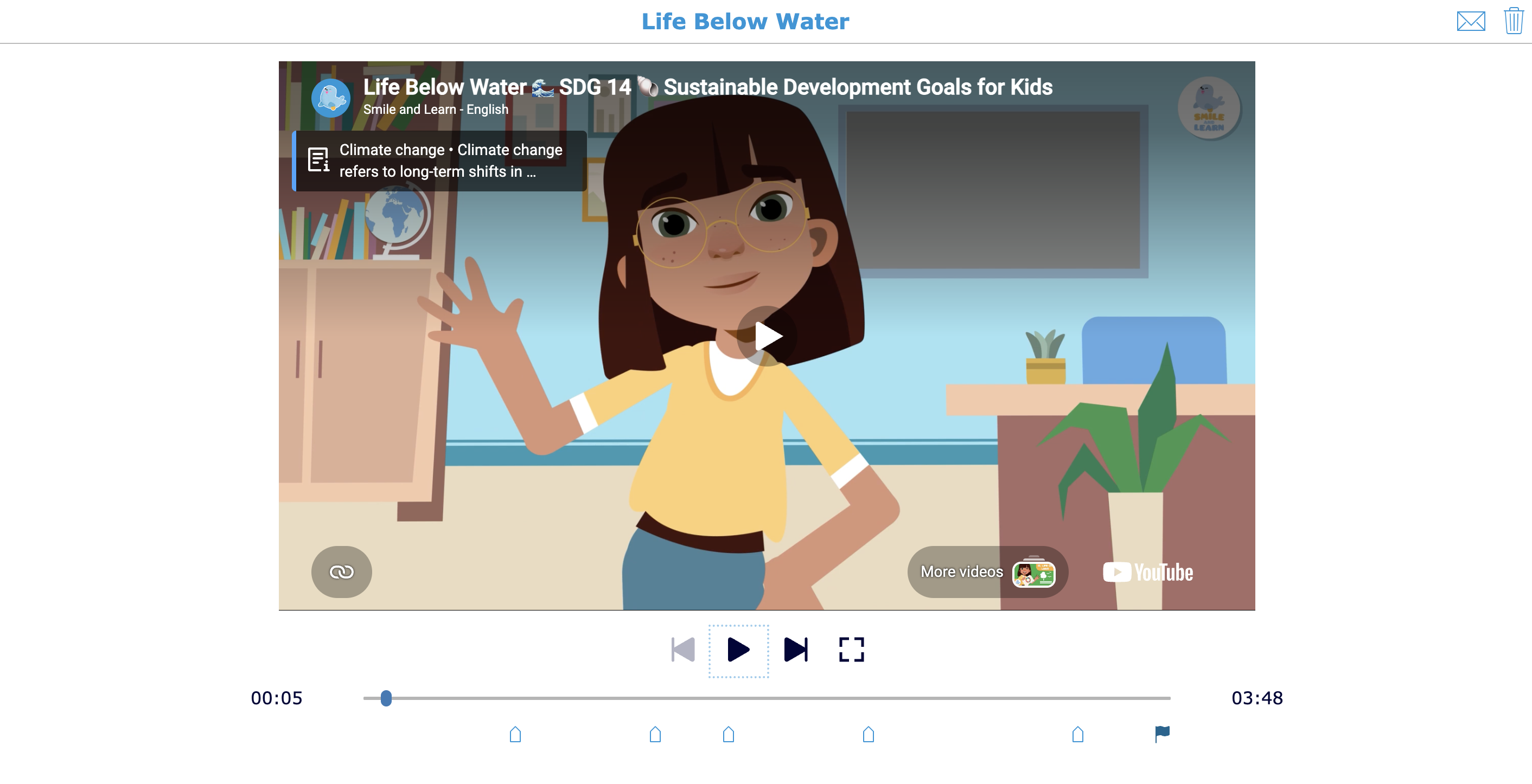
This Life Below Water Video Quiz is a great introduction to SDG 14 for younger learners. Students watch a short video and answer questions while they learn what “Life Below Water” means, why oceans are important, and how people can help protect marine life.
Because the questions are built into the video, students stay focused while watching. Instead of passively viewing the content, they stop, think, and respond at key moments. This makes the activity useful as a lesson starter, homework task, or first activity in an SDG 14 mini-unit.
2. The Plastic Problem – Split Worksheet
| Icon | Area | Explanation |
|---|---|---|
| 🎓 | Subject & Grade | Science, geography, and environmental education — middle school |
| 🎯 | Learning goal | Students explain how plastic pollution affects oceans, marine animals, and human communities. |
| 🧩 | BookWidgets widget type | Split Worksheet |
| ⏱️ | Time needed | 20–30 minutes |
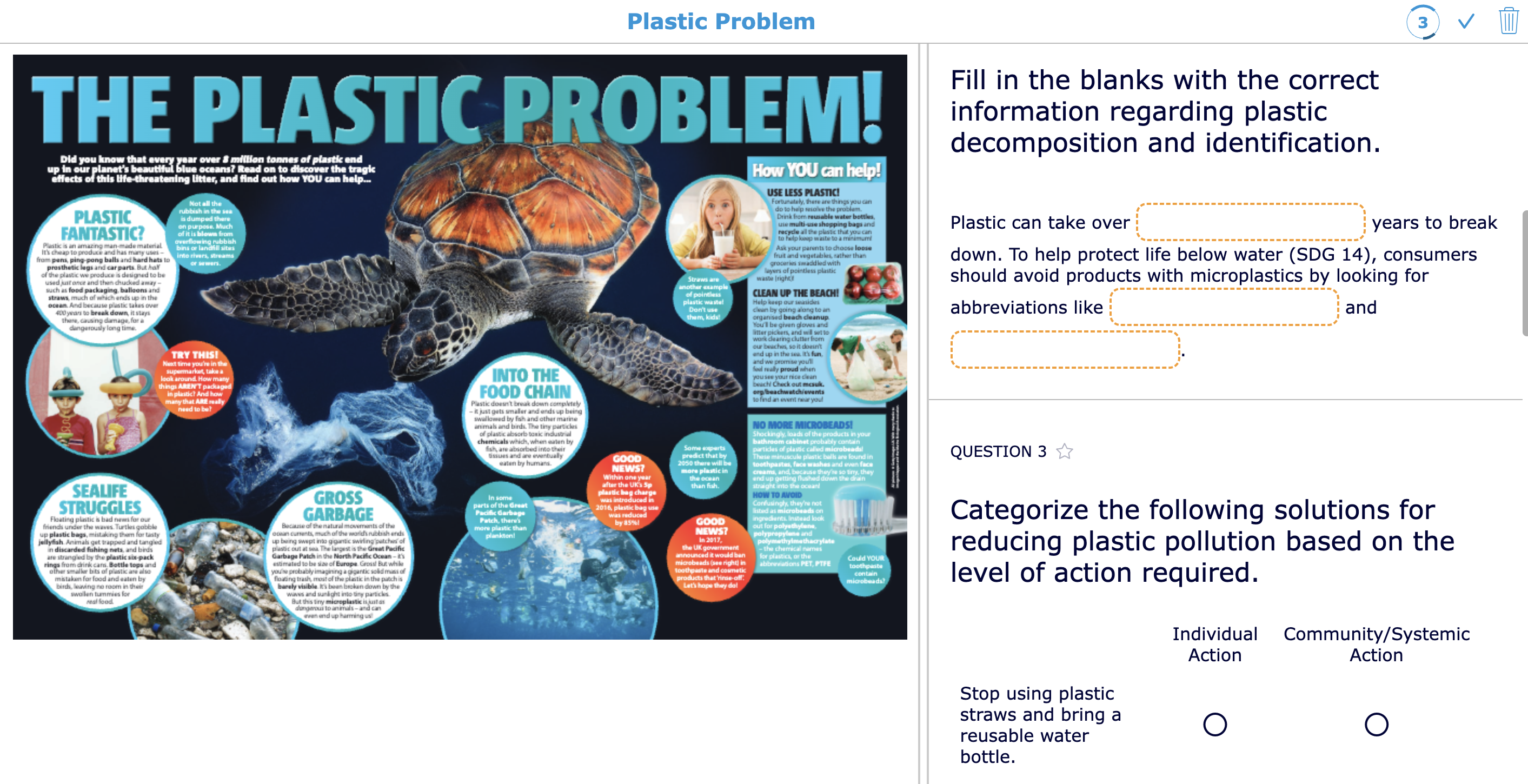
This Split Worksheet about the plastic problem helps students investigate one of the most visible issues connected to SDG 14: plastic waste in oceans. Students can read information, view images, or watch supporting content on one side of the screen while answering questions on the other side.
The activity guides students from understanding the problem to thinking about solutions. They can explore how plastic reaches the ocean, why it is harmful to marine animals, and what people, schools, and communities can do to reduce plastic waste.
3. The terminology of SDG 14 - Word Search
| Icon | Area | Explanation |
|---|---|---|
| 🎓 | Subject & Grade | Science, geography, biology, and sustainability — high school |
| 🎯 | Learning goal | Students recognize and review key vocabulary related to SDG 14 and ocean sustainability. |
| 🧩 | BookWidgets widget type | Word Search |
| ⏱️ | Time needed | 10–15 minutes |
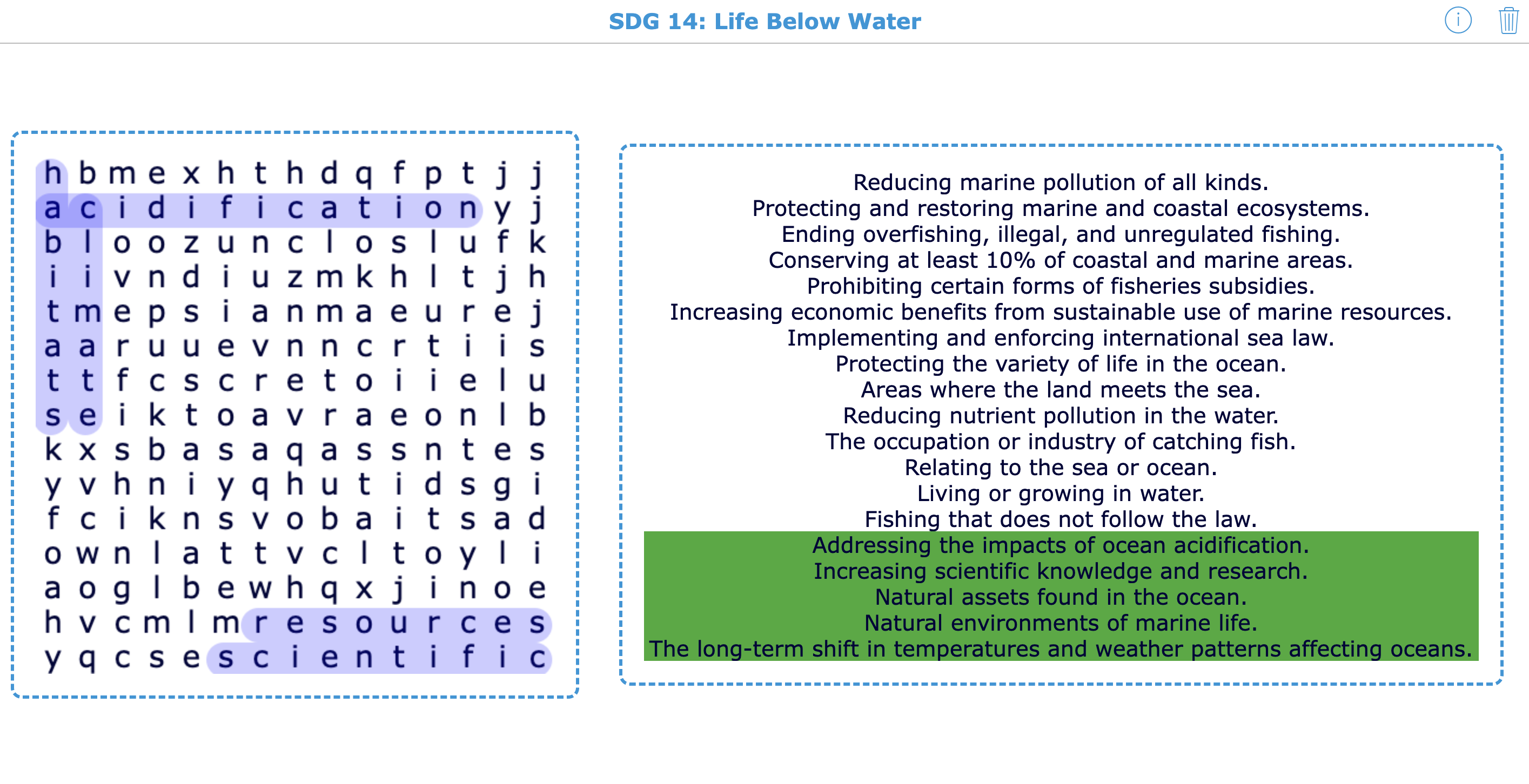
This SDG 14 Word Search helps students become familiar with important vocabulary before or after a lesson about Life Below Water. Students search for terms linked to ocean protection, marine ecosystems, pollution, sustainability, and biodiversity.
A vocabulary activity like this is simple, but it can be very useful. Many SDG 14 topics contain subject-specific words that students may not use in everyday language. Reviewing these terms first makes it easier for students to understand texts, videos, discussions, and research tasks later in the lesson.
4. Ocean Pollution - Crossword Puzzle
| Icon | Area | Explanation |
|---|---|---|
| 🎓 | Subject & Grade | Science, geography, and environmental education — middle school |
| 🎯 | Learning goal | Students review key concepts about ocean pollution and connect vocabulary to meaning. |
| 🧩 | BookWidgets widget type | Crossword Puzzle |
| ⏱️ | Time needed | 15–20 minutes |
This Ocean Pollution Crossword Puzzle helps students review what they know about pollution in seas and oceans. Students use clues to identify important terms connected to plastic waste, chemicals, marine animals, ecosystems, and human impact.
The crossword format works well after students have already learned the basic content. It encourages them to recall definitions and make connections between concepts instead of simply recognizing words in a list.

5. What's in the deep? Whale Sharks! - Worksheet
| Icon | Area | Explanation |
|---|---|---|
| 🎓 | Subject & Grade | Science and biology — upper primary to middle school |
| 🎯 | Learning goal | Students explore whale sharks and describe why protecting marine species matters. |
| 🧩 | BookWidgets widget type | Worksheet |
| ⏱️ | Time needed | 25–35 minutes |
This Whale Sharks Worksheet takes students into the deep sea by focusing on one fascinating marine animal. With a video, 3D model, and trivia flashcards, students can learn about whale shark characteristics, habitat, behavior, and conservation in a more visual and interactive way.
This activity is a strong choice when you want students to connect SDG 14 to a real species. Instead of only talking about “marine biodiversity” in general, students investigate an animal that can spark curiosity and discussion.

6. Coral Reefs – WebQuest
| Icon | Area | Explanation |
|---|---|---|
| 🎓 | Subject & Grade | Biology, geography, environmental science, and global citizenship — high school |
| 🎯 | Learning goal | Students investigate why coral reefs are threatened and propose ways to protect them. |
| 🧩 | BookWidgets widget type | WebQuest |
| ⏱️ | Time needed | 35–50 minutes |
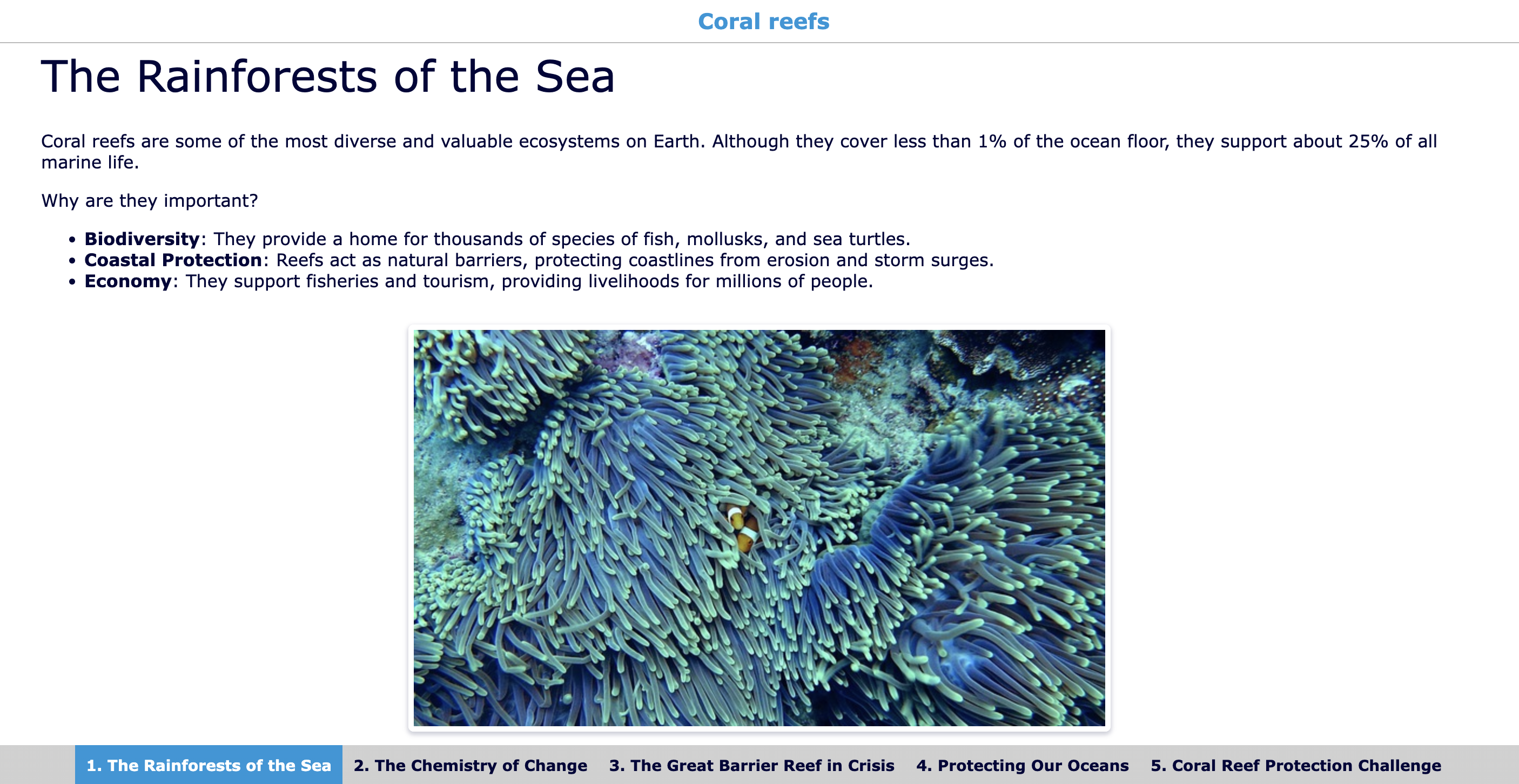
This Coral Reefs WebQuest guides high school students through an inquiry-based investigation into coral reef ecosystems. Students explore why coral reefs are important, what threats they face, and what can be done to protect and restore them.
The WebQuest format is ideal for SDG 14 because students need to use information, compare ideas, and think critically. They are not just receiving facts about coral reefs; they are researching, interpreting, and forming their own conclusions.
7. Plink Goes to the Sea - Split Worksheet
| Icon | Area | Explanation |
|---|---|---|
| 🎓 | Subject & Grade | Science, early geography, and storytelling — grade 1 primary school |
| 🎯 | Learning goal | Students recognize that the sea is home to living creatures and should be kept clean. |
| 🧩 | BookWidgets widget type | Split Worksheet |
| ⏱️ | Time needed | 10–20 minutes |
Plink Goes to the Sea is a gentle SDG 14 lesson starter for young learners. Through a simple story-based activity, first-grade students can begin talking about the sea, sea animals, pollution, and caring for nature in an age-appropriate way.
The Split Worksheet format helps young students follow along with visual or story content while responding to simple prompts. It can be used as a whole-class activity on an interactive board or as an individual activity with teacher support.

8. Conversation starter - Jigsaw Puzzle
| Icon | Area | Explanation |
|---|---|---|
| 🎓 | Subject & Grade | Early childhood education, science, and speaking skills — kindergarten and toddlers |
| 🎯 | Learning goal | Children observe an ocean-themed image and talk about sea life, water, and caring for nature. |
| 🧩 | BookWidgets widget type | Jigsaw Puzzle |
| ⏱️ | Time needed | 5–10 minutes |
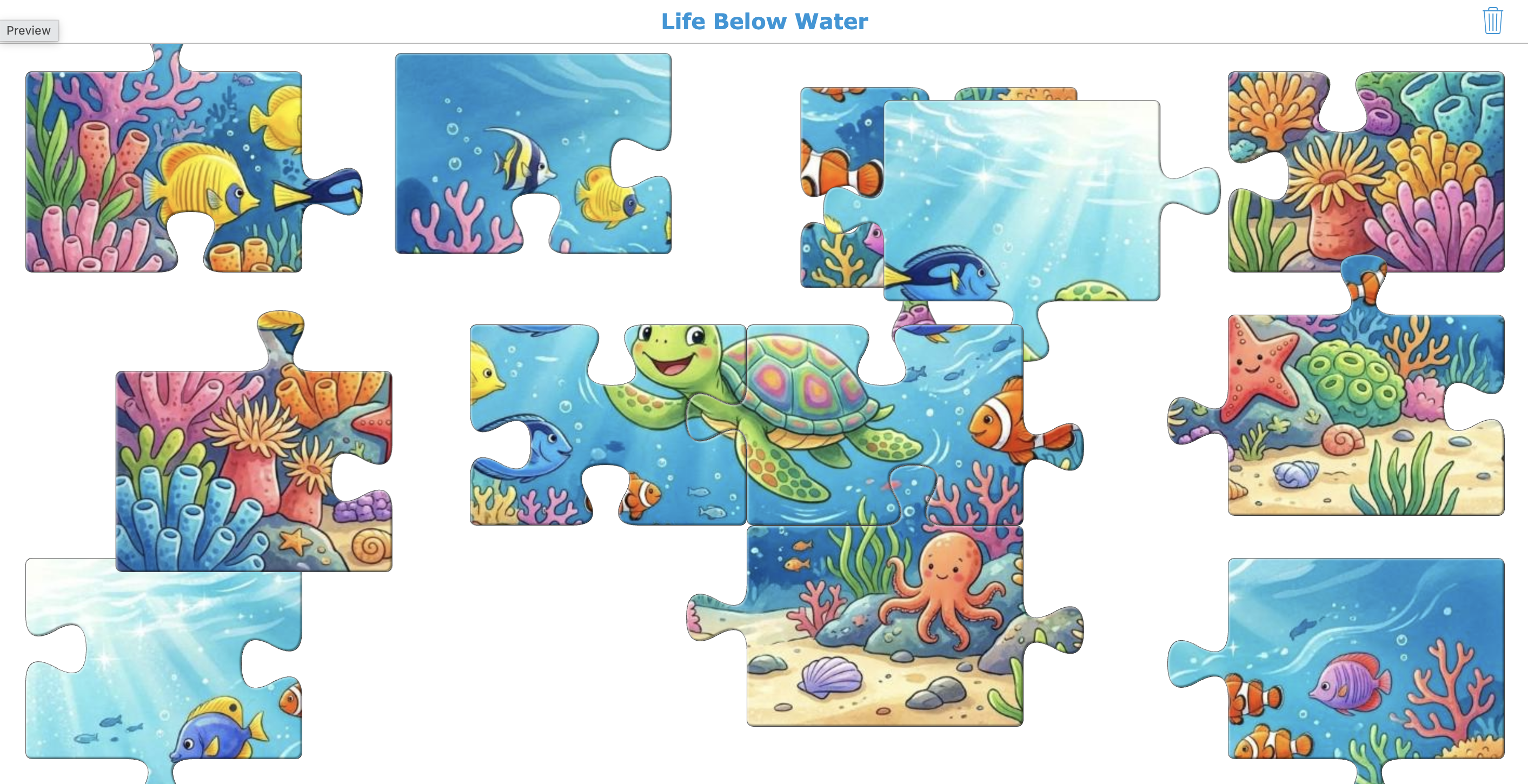
This SDG 14 Jigsaw Puzzle is a simple but effective conversation starter for very young learners. Children complete an ocean-themed puzzle and then talk about what they see in the image.
For kindergarten students and toddlers, the goal is not to explain SDG 14 in detail. The goal is to build early awareness: the sea is a place where animals live, water should stay clean, and people can help take care of nature.
More ready-to-use SDG lesson plans and resources
Reminder: This is part ten of our blog post series with lesson activities for teaching the United Nations Sustainable Development Goals. We will post a new blog about the next SDG every month. Go check out earlier blog posts on the SDGs:
- 8 Engaging Lesson Plans to Teach "SDG 1: No Poverty" to Your Students
- 8 Creative Ways to Teach "SDG 2: Zero Hunger" to Your Students
- 8 Free Lesson Plans to Teach "SDG 3: Good Health and Well-Being"
- Bringing SDG 4 into the Classroom: 8 Lesson Ideas for Quality Education
- 8 Free Lesson Plans on SDG 5 Gender Equality for all Grade Level Students
- 8 Free Digital Lessons for Teaching SDG 6: Clean Water and Sanitation
- 8 Exciting Lesson Ideas to Teach Students About SDG 7: Affordable and Clean Energy
- 8 Digital Lessons to Teach Students about SDG 8: Decent Work and Economic Growth
- 8 Creative Ways to Teach SDG 9 - Infrastructure, Industrialization and Innovation - in Your Classroom
- SDG 10 Explained for Students: 8 Digital Lesson Plans on Reduced Inequalities
- Bringing SDG 11 into the Classroom: 8 Lesson Ideas for Sustainable Cities & Communities
- 8 Creative Lesson Plans to Teach SDG 12: Responsible Consumption & Production
- 8 Digital Lessons on SDG 13 to Engage Students with Climate Change
And if you can't wait this long for all the other posts, we've already created 1 lesson for each SDG in this digital group work planner activity. Here's the blog post about teaching the SDGs. You can find all the separate SDG activities in this BookWidgets group folder, in case you want to duplicate the activities and make some changes.
Wrap up
Teaching SDG 14: Life Below Water helps students understand why healthy oceans matter and how their choices can make a difference. From plastic pollution and overfishing to coral reefs and marine biodiversity, this topic gives students real-world problems to explore, discuss, and act on.
With BookWidgets, you can turn SDG 14 into interactive digital lessons students actually engage with. Use the ready-to-use quiz, worksheet, jigsaw puzzle, WebQuest, Crossword, and many more activity templates to help students learn about ocean challenges step by step.
Copy and share the BookWidgets activities from this BookWidgets group to your account, adapt them to your students’ level, and share them through your LMS. Your students will not only learn what SDG 14 means, but also discover practical ways to help protect life below water.
Want to learn more about creating engaging lesson activities with BookWidgets?
✔️ Sign up for upcoming free webinars and view recordings on the BookWidgets Teacher Academy Page.
✔️ Learn more about our special, limited-time pricing for groups of teachers for purchasing BookWidgets now without having to wait for the next school year or budget cycle.
✔️ Follow BookWidgets on BlueSky and LinkedIn and join our teacher community on Facebook!
And me? I'm Lucie from BookWidgets. Follow me on LinkedIn 👋

FAQ: Teaching SDG 14 with digital lesson activities
What is a good digital lesson activity for teaching SDG 14?
A good digital lesson activity for SDG 14 helps students understand ocean challenges and connect them to real-world action. For example, teachers can use a BookWidgets quiz to introduce Life Below Water, a sorting activity about marine pollution, a food web worksheet about ocean ecosystems, or a WebQuest about sustainable fishing.
Are these BookWidgets SDG 14 lesson templates ready to use?
Yes. These lesson ideas are designed as ready-to-use BookWidgets activities. Teachers can copy them to their own BookWidgets account, adapt the questions or instructions, and share them with students through their LMS.
Can I use these SDG 14 activities in Google Classroom or another LMS?
Yes. Teachers can share BookWidgets activities through Google Classroom, Microsoft Teams, Canvas, Moodle, and other learning management systems. Students complete the interactive activity digitally, and teachers can review student work in the BookWidgets reporting dashboard.
How can I make an SDG 14 lesson more interactive?
You can make an SDG 14 lesson more interactive by using quizzes, drag-and-drop sorting questions, image-based questions, timelines, WebQuests, exit tickets, and digital worksheets. These formats help students actively explore topics such as plastic pollution, ocean food webs, coral reefs, and sustainable fishing.
What digital tools can teachers use for teaching Life Below Water?
Teachers can use BookWidgets to create interactive SDG 14 lessons such as quizzes, worksheets, timelines, WebQuests, exit tickets, and project templates. These activities help students investigate ocean issues, reflect on their learning, and create action plans.


